back to menue here

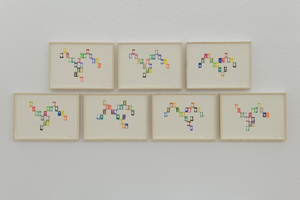
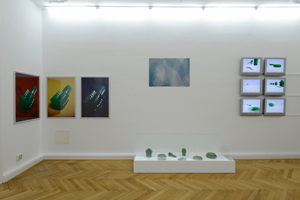
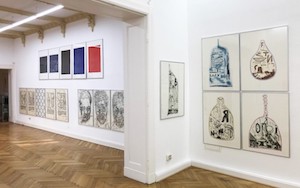
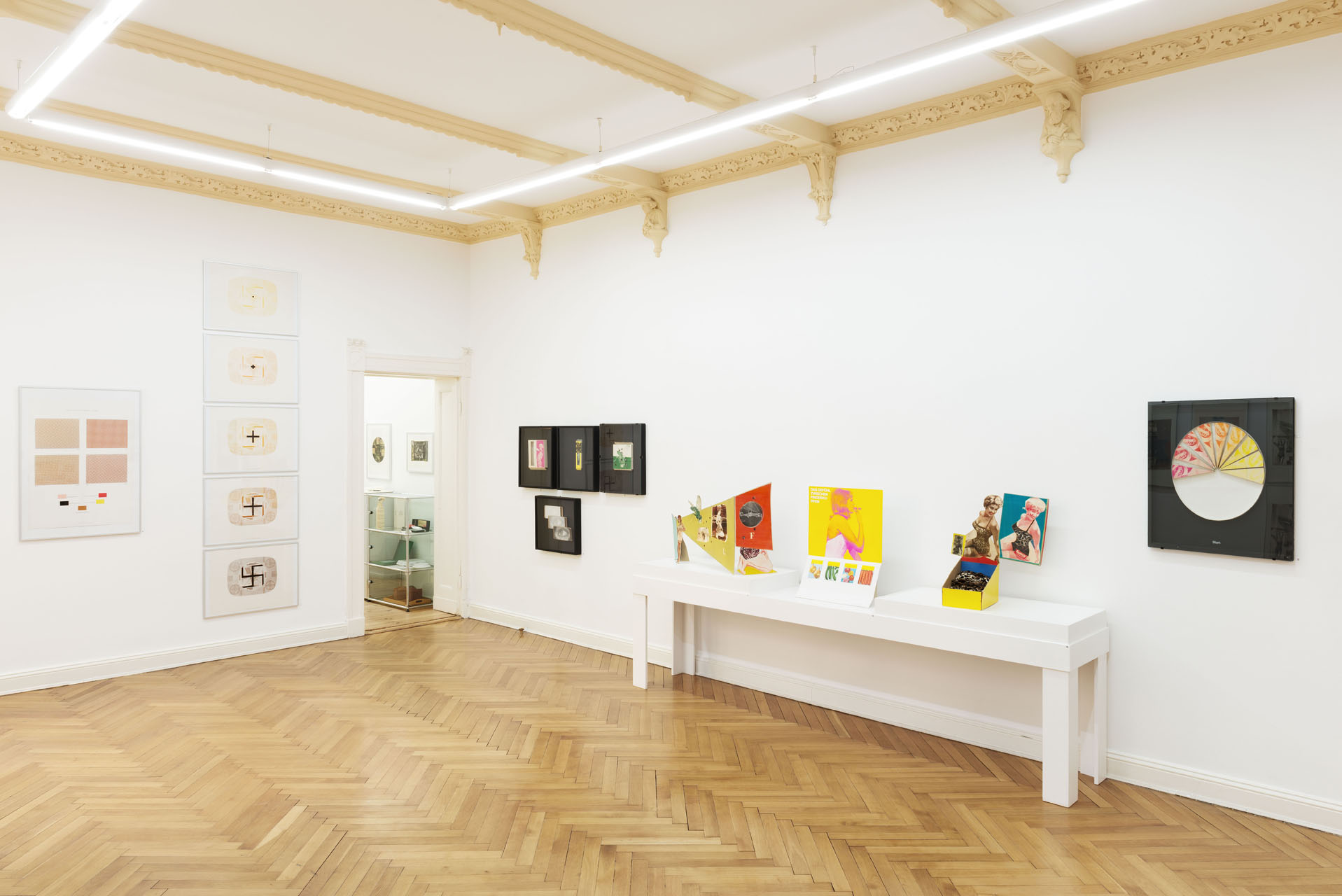
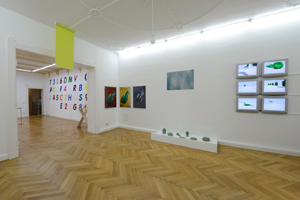
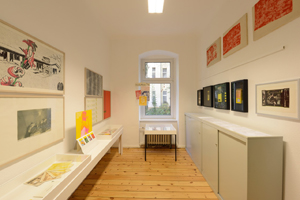
Having moved into new and large-scale exhibition spaces in 2008, Edition Block now presents the exhibition 3 "→ ∞" which includes works by Marina Abramovic, Nevin Aladag, Halil Altindere, Maja Bajevic, Henning Christiansen, Danica Dakic, Braco Dimitrijevic, Maria Eichhorn, Ayse Erkmen, Mona Hatoum, Sanja Ivekovic, Sejla Kameric, Gülsün Karamustafa, Jaroslaw Kozlowski, Vlado Martek, Aydan Murtezaoglu, Anri Sala, Bülent Sangar, Sarkis, and Nasan Tur, and presents an overview of the production of the recent years. In the course of the last 40-plus years, Edition Block has constantly moved along new paths in the field of multiplied art and thus written part of art history. To date, it has brought out almost 80 works in collaboration with international artists. All in all, it is a wide-ranging network that has included all the experiences of art in the 1960s, 1970s, 1980s and 1990s, and now with trends in 21st-century art.
"PFM-1 and others" (2004) by Ayse Erkmen - the first video installation ever published in an edition - shows on several monitors computerized animations of landmines. In rubber-like, almost organic gestalt they appear from the background, accompagnied by synthetic sounds, and jump into the foreground just to disappear again with a buzzing. By stageing an absurd and bizarre parade the deadly weapons are indeed defused by Erkmen, but still a distressing impression of their deadly force remains.
"Bosnian Girl" (2007) by Sejla Kameric results from the preoccupation with an usurping past but at the same time implies something more. Kameric does not regard art as a goal but as a means of self-identification and intermediation. The media and the reality which surrounds her are the points of reference for the artist who grew up in Sarajewo, the city that was besieged by war for more than three and a half years. "Bosnian Girl" is an examination of the tragedy of Srebrenica but also of the phenomenon of country-specific prejudices. The debasing graffiti quoted in this work was written on the wall of a barracks in Srebrenica by an unknown Dutch soldier in 1994/95.
The artist Aydan Murtezaoglu deals in her works with the boundaries and structural constraints of Turkish society and how gender roles are formed through family relationships - as well as with possible routes of escape, practices of disobedience and resistance, and gestures of disruption. The motifs of "IN CHARGE" (2009) depict reenactments of situations from the domestic and public spheres. While the artist herself is always one of the central protagonists, her intent is not to resurrect autobiographical incidents. Rather, Murtezaoglu assumes a proxy position and assumes responsibility for examining different aspects of certain role models and the background for their development.
Maria Eichhorn's projects constitute an inquiry into the concept of art, the reception and localization of art, the autonomy and authorship of works of art. Her works could be described as investigations at the threshold of the perceptible. Her projects and interventions are often so minimal that they will elude an exhibition visitor's hurried glance. Yet they evoke an ambiguous interplay around perceptual issues - not just sensory perception and concrete experience, but also and most emphatically the perception of politically and socially relevant questions and problems. Maria Eichhorn's projects are often developed in collaboration with colleagues from other disciplines. And they often contain instructions for actions or precise guidelines for implementation, as does the artist's multiple titled "Vier Multiples in Tasche" (2009) [Four Multiples in Bag]. The future owner is challenged to get into the act and complete the work by following various instructions given by the artist.
The importance of language and the ties that bind it to culturally coded patterns of understanding as well as the active power of political conceptions are recurrent motifs in Nasan Tur's oeuvre; "City says …" is about the interrelation between language and the public space. Since 2007, the ongoing work has so far been realized in Ljubljana, Berlin, Milan, Belgrade, Stuttgart and Vienna. The artist always begins by collecting hundreds of graffiti from the city he works in, focusing not on the tags left by the sprayer scenes but rather on what are called message graffiti-messages, consisting of individual words or short sentences, that make significant statements. By transposing these graffiti into the context of art, Nasan Tur questions the boundaries separating inside from outside, high culture from subcultures, anonymity from visibility. The formal treatment of these messages, which the artist uses in their entirety without regard for their content, differs from place to place. In Ljubljana, a collection was published on one page in the local daily newspaper, whereas Stuttgart's graffiti were published in an artist's book. In other cities, such as Berlin or Vienna, the artist, in a piece of performance art, sprayed all the slogans he had collected onto one wall of the exhibition space, one on top of the other, so that the result was an impenetrable color field with frayed edges. What the work left behind was a wall painting that represented a compressed version of the city's subtext. This year, Nasan Tur has translated the graffiti from the six cities into color etchings for the portfolio "City says…". The messages have been superimposed by the stylus - in a manner analogous to the spray performances - and appear in the prints in mirror image. The densities and superimpositions are finally indecipherable, though the finely wrought strokes do not completely cover the surface, so that individual words, word fragments, or letters remain legible. Yet the statements stay hidden, lost in the web of lines. The drawing process creates heterogeneous images in which the character of direct address, the sociopolitical relevance and the information contained in the individual messages disappears. Their full significance can no longer be perceived. The image becomes a metaphor for failed - or at least disrupted - communication.


Ayse Erkmen
PFM-1 and others
2004


Sejla Kameric
Bosnian Girl
2007


Henning Christiansen
Die Freiheit ist um die Ecke
2008


Jaroslaw Kozlowski
Rhetorical Figures II
2006


Maria Eichhorn
Vier Multiples in Tasche
2009


Nasan Tur
City says...
2010 (detail)


more on exhibitions to have been shown prevoiusly here