
more on exhibition to be shown currently here
back to menue here
more on exhibition to be shown currently here


|
Alicja Kwade Multiples 2008 – 2014 |
|
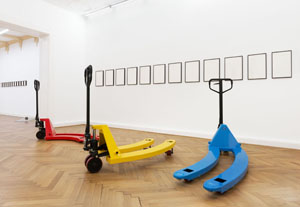 Alicja Kwade Hubwagen, 2013 © Edition Block, Berlin
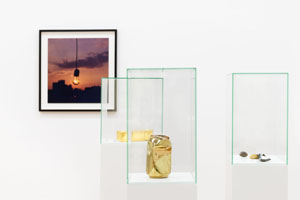 Alicja Kwade "Light loss", 2009 "Bordsteinjuwelen", 2008 © Edition Block, Berlin |

TÜRKIYE´DE GÜNCEL SANAT
A book series published by YKY Istanbul
December 10, 2011 - March 3, 2012
|
The Contemporary Art in Turkey series, published by Yapi Kredi Kültür Publications, consists of twelve volumes, eleven of them monographs on individual artists. An important feature of this series is that each monograph includes an original print by the artist that ingeniously doubles as the book jacket. The artists in this series of monographs are Hale Tenger, Gülsün Karamustafa, Füsun Onur, Kutlug Ataman, Ayse Erkmen, Halil Altindere, Cengiz Cekil, Aydan Murtezaoglu, Bülent Sangar, Esra Ersen and Sarkis. The twelfth volume presents the artists Nevin Aladag, Vahap Avsar, Ergin Cavusoglu, Nezaket Ekici, Sakir Gökcebag, Nilbar Güres, Servet Kocyigit, Ahmet Ögüt, Ebru Özsecen, Anny und Sibel Öztürk, Canan Tolon and Nasan Tur, whose works are currently on view in the exhibition "Zwölf im Zwölften" (12 in the 12th) at TANAS - project space for contemporary Turkish art. Esen Karol, the designer of the entire series, was asked to create the graphic work for this volume. The publisher's desire to bring the fascinating developments in Turkish art during preceding years to the attention of a larger audience was the impetus for the book series in 2007. Artists were selected who, in the 1980s, radically broke with the conventions of Turkish art, which made them outsiders not only in the global, Western-oriented art scene but also in their own land. They had no support from state institutions and none from private foundations either. Largely ignored by both Turkish art critics and the local market, they worked for a small circle of art lovers consisting for the most part of other artists. Virtually unnoticed by the mainstream art scene, an entire generation of artists burgeoned and matured until the Istanbul Biennials of the 1990s catapulted them into the international limelight. There they were hailed as provocative, political, critical, aesthetically radical, and fresh - there was talk of the "miracle of Istanbul." Since that time, these artists have regularly taken part in international exhibitions. The twelfth volume of the series, titled At Home, Wherever, presents twelve artistic positions that seem initially to have only one thing in common: that the artists live and work, entirely or for the most part, outside Turkey. Some of them took steps of their own free will to make their way in a new environment. Others were unable to decide on their own, having left Turkey with their parents when they were still children. They grew up in an unfamiliar country, learned the foreign language, went to school there and later to art schools, just like those who were born Turkish abroad. Even if twists of fate took these artists to these particular places for the most disparate reasons - the texts by the book's twelve authors profoundly relate their stories - an additional commonality among the artists can be mentioned: their thinking and their work have been inspired by a new energy emanating from Istanbul. Especially the youngest artists, who did not grow up in Turkey, are again and again drawn to the Bosporus by the tension between their workplaces abroad and the dynamic Istanbul scene. From a thoroughly distanced foreign perspective, they search for their (second?) identity. |
|
 Hale Tenger World Cracker, 1992 / 2007 Offset print, 62 x 88 cm
 Gülsün Karamustafa Like Squirrel..., 2007 Offset print and gold hot stamp, 88 x 62 cm
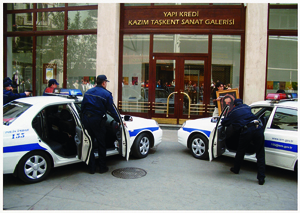 Halil Altindere Surrender, you have been surrounded!, 2005-2008 Offset print, 62 x 88 cm
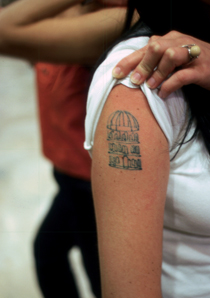 Sarkis Untitled, 200 / 2010 Offset print, 88 x 62 cm
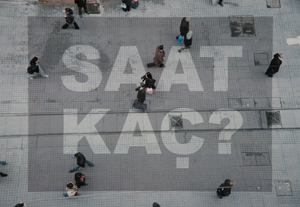 Cengiz Cekil What time is it?, 2008 Offset print, 62 x 88 cm |
TO MULTIPLY IS HUMAN
Edition Block 45 Years 1966 - 2011
September 10 - November 26, 2011
|
Joseph Beuys, Barbara Bloom, KP Brehmer, Marcel Broodthaers, John Cage, Henning Christiansen, Philip Corner, Maria Eichhorn, Ayse Erkmen, Robert Filliou, Richard Hamilton, Mona Hatoum, Dick Higgins, KH Hödicke, Rebecca Horn, �ejla Kameric, Arthur Köpcke, Jaroslaw Kozlowski, Olaf Metzel, Aydan Murtezaoglu, Ebru Özseçen, Nam June Paik, Blinky Palermo, Sigmar Polke, Gerhard Richter, Diter Rot, Gerhard Rühm, Bülent Sangar, Carles Santos, Sarkis, Nasan Tur, Wolf Vostell, et al. Edition Block was founded in 1966. In the early 1970s it moved into its own space in (West-) Berlin's Schaperstraße (Wilmersdorf), right next door to Galerie Block. It is among the oldest still active publishers of multiple objects and prints by contemporary international artists. The founding of the Edition tied in not only with the discussion around the object, which had been touched off in postwar years by the artists of Nouveau Réalisme, but above all with the idea of a duplicated - and therefore democratized, because affordable - art, as advocated primarily by the Fluxus movement. The multiple offered not just the opportunity to discuss the problem of the "original", the social stance of artistic work, and the relationship between art and commodity; multiples at the same time assured the broad dissemination of artistic statements that reflected the state of art and took up key positions within contemporary thought. The first editions from Edition Block were produced in collaboration with artists such as Wolf Vostell, Joseph Beuys, KP Brehmer, KH Hödicke, Sigmar Polke, Palermo, Konrad Lueg, Nam June Paik, Arthur Köpcke, Dieter Rot and Robert Filliou. In subsequent years, the program expanded steadily with new artists and the latest art forms, always characterized by René Block's Fluxus principle of artistic networking and his interest in the periphery and "artistic sidestreams". In addition to the object multiples, Edition Block's interest lay (and lies) primarily in prints and the various graphic art techniques. Besides issuing single sheets by different artists, the Edition has frequently published portfolios, such as Grafik des Kapitalistischen Realismus (1967) and Weekend (1971). The principle of assembling several artists for a joint edition is also operative in En Bloc (1969-72), a roll-top cabinet made of wood, whose drawers house objects by 19 German artists as if in a museum en miniature. After the gallery closed (1979) and while Block worked with institutions (the Artists-in-Berlin Program of the DAAD 1982-92, IfA Stuttgart 1993-95 and Kunsthalle Fridericianum 1998-2006), the activities of the Edition were scaled back. It concentrated its focus on the interaction between visual art and music. During this period, editions were released mainly in the form of LPs and CDs, with works by Conrad Schnitzler, David Tudor, Ivan Wyschnegradsky, Claus Böhmler, Philip Corner, Henning Christiansen, Gerhard Rühm, Joseph Beuys, Nam June Paik and Marcel Duchamp. A special multiple in the musical field is Mozart Mix (1991) by John Cage, the artist's homage to the composer Wolfgang Amadeus Mozart. This was the first sound environment involving multiplication. In 2005 editorial activity turned to a large graphic art project. In conjunction with the Cetinje Biennale Love It or Leave It (2004), Edition Block published the eponymous portfolio with prints by 30 artists in a variety of techniques. In 2007 Edition Block became a corporation under the management of Anna Block and moved into new quarters at Heidestraße 50 (Tiergarten). René Block remained the artistic advisor; organizational direction now lies in the hands of Barbara Heinrich. Productions with young artists from southeastern Europe such as Bülent Sangar, Aydan Murtezaoglu and �ejla Kameric stand alongside new works by "old friends" like Henning Christiansen, Jaroslaw Kozlowski and Carles Santos. In its now 45-year-long history, Edition Block has constantly taken new directions in the field of multiplied art and, in so doing, also written a chapter of art history. To date, 77 works have been produced in collaboration with more than 80 artists - all in all, a far-flung network that, building on all the experiences of the 1960s, '70s, '80s and '90s, now dedicates itself to the artistic developments of the 21st century. The exhibition curated by Barbara Heinrich presents all the editions published since 1966, among them "milestones" such as Schlitten (1969) and Filzanzug (1970) by Joseph Beuys, �höhere Wesen befehlen (1968) by Sigmar Polke, The Critic Laughs (1968-71) by Richard Hamilton and Der Denker (1976/78) by Nam June Paik, along with works by Maria Eichhorn, Ayse Erkmen, Mona Hatoum, Olaf Metzel, Ebru Özseçen, Sarkis and Nasan Tur from the year 2010/2011. An exhibition catalogue in the form of a ring binder contains detailed descriptions of all the editions. |
|
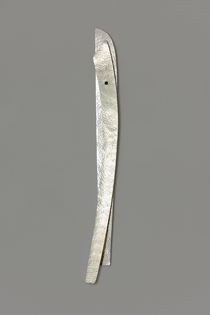 Ayse Erkmen 925, 2011 Silver, sheath of cotton fabric H: 66,5 cm © Edition Block, Berlin
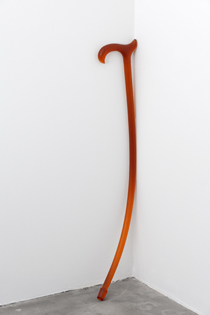 Mona Hatoum Untitled (stick), 2011 Silicone H 87 cm © Edition Block, Berlin
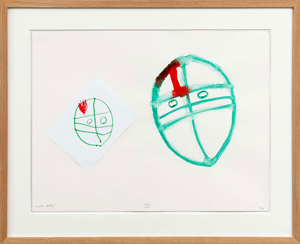 Sarkis Nach Anton, 2011 Montage: water color and color photograph 62,5 x 77 cm (framed) © Edition Block, Berlin
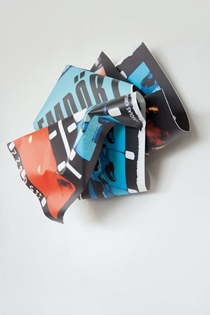 Olaf Metzel Empört, 2011 Aluminium, stainless steel, digital print 130 x 150 x 70 cm © Edition Block, Berlin
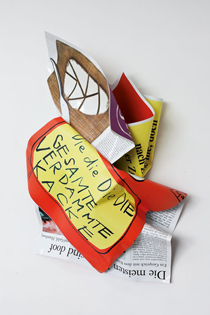 Olaf Metzel Die, die Die..., 2011 Aluminium, stainless steel, digital print 205 x 140 x 75 cm © Edition Block, Berlin
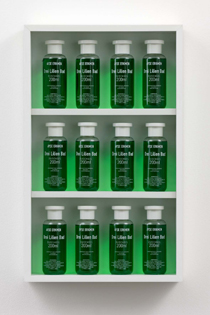 Ayse Erkmen Drei Lilien Bad, 2002 12 bottles filled with shower gel composed by the artist, wooden box 53 x 32,5 x 8 cm © Edition Block, Berlin
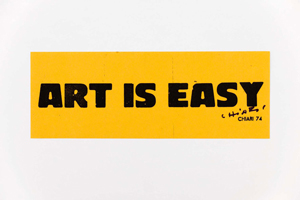 Giuseppe Chiari ART IS EASY, 1974 Offset lithograph with stamp die "CHIARI 74" 12,5 x 34,5 cm © Edition Block, Berlin |
GRAFIK DES KAPITALISTISCHEN REALISMUS
KP Brehmer, KH Hödicke, Konrad Lueg, Sigmar Polke,
Gerhard Richter, Wolf Vostell
Graphic arts and prints until 1971
March 5 - July 30, 2011
|
In 1968, the year of student revolts, and at the height of the politicization of society, René Block brought out a portfolio in an edition of 80 with Stolpe Verlag, Berlin: Grafik des Kapitalistischen Realismus [Graphic Art of Capitalist Realism]. The works were by KP Brehmer, K. H. Hödicke, Konrad Lueg, Sigmar Polke, Gerhard Richter and Wolf Vostell and had all been created within the previous year. The six screen prints comprising the portfolio are comments on affluent Western society that range from droll to critical. Already ironic is the text of the print used as a foreword, where Block commends the works of the artists, then largely unknown, to true connoisseurs among art collectors as "the type of realism made, cultivated and tended by true masters in cities like Berlin, Düsseldorf and Cologne". The works of Polke, Richter and Vostell stake out the artistic territory in which their colleagues' work can also be situated. While Polke aligns the banal promises of West Germany's economic miracle with the halftone dots of cheap newsprint in Wochenendhaus [Weekend Cottage], the threatening presence of Vostell's spangled Starfighter is a critical, dissent-provoking metaphor for rearmament under Adenauer. The moody privacy of Richter's Hotel Diana, a screen print based on the artist's photograph of himself and Polke in an Antwerp hotel room also is an ironic comment on prevailing artistic pretensions about assuming social responsibility. In the prints by Brehmer and Lueg, advertising images and impressions from daily life are reworked into statements variously erotic or emblematic, or critical of consumerism, while Hödicke shifts his investigation of optical impressions from painting to printing, tackling themes such as painterly methods, artistic gesture and the relationship between reality and illusion. All six works use contemporary artistic means to reflect on living conditions in Western industrial society, which justifies the label "capitalist realism" if "realism" is defined as an artistic method with which the artist influences "contemporary reality in a way that not only informs and confirms, but also transforms and enlightens". (Klaus Herding: "Mimesis und Innovation. Überlegungen zum Begriff des Realismus in der bildenden Kunst" [Thoughts on the Concept of Realism in the Visual Arts] in: Klaus Oehler (Ed.), Zeichen und Realität, Tübingen 1984, 2. 102 f.) The term did not come from René Block, though; it was first used in 1963 in connection with an exhibition in Düsseldorf by Gerhard Richter together with Manfred Kuttner, Lueg and Polke. Except for Hödicke, who had studied in Berlin with Fred Thieler, all of the portfolio's artists had studied at the Staatliche Kunstakademie Düsseldorf - even Vostell, for a time, after his studies in Paris. By the time Joseph Beuys was appointed professor in 1961, the school had become a mecca for artists and students. During those years, two advanced positions that had decisive and lasting significance for many artists could be observed in academy circles: Fluxus und Pop. In this exciting environment, and inspired by activities in London, New York and Paris, which they were familiar with from the relevant art journals, Konrad Lueg, Sigmar Polke, Gerhard Richter and their fellow student Manfred Kuttner appeared on the scene in the spring of 1963. From May 11th to 26th, their works were shown in a storefront gallery in Düsseldorf's Kaiserstraße (diagonally across from the former Galerie 22) in a "special exhibition of graphic art and painting" that was described in a press release signed by Richter as the "first exhibition of 'German Pop Art'": "For the first time in Germany, we are showing pictures that can be labeled with terms like Pop Art, Junk Culture, Imperialist or Capitalist Realism, Neo-figuration, Naturalism, German Pop and a few other similar terms." Just half a year later, on the night of October 11th, in the Berges furniture store, also in Dusseldorf, Gerhard Richter and Konrad Lueg organized the "Demonstration for Capitalist Realism", in which they proselytized "Life with Pop". The anarchic aspect of this event is unmistakably indebted to the Fluxus aesthetic. The evening's focal point was not so much the pictures, painted in the Pop style, but the event's action character: the presence of the artists and the inclusion of the entertained audience were elements of the happening. And beyond that, the claim was to bring life and art closer together by attempting to eliminate the distinction between mass-merchandise and high-level art in a furniture store. The novelty of this artistic approach fascinated René Block. At a German Künstlerbund exhibition in the spring of 1964, Block took note of Vostell, Lueg and Richter, afterward visiting them in Düsseldorf, where he also got to know Polke, and he was able to enlist their collaboration; then came the Berlin based artists Brehmer and Hödicke. From September 16th to November 5th 1964, Block presented his first exhibition under the title Neodada, Pop, Décollage, Kapitalistischer Realismus. The "demonstrative exhibition", which Block also envisioned as introducing his upcoming program, attracted attention. For the gallery's first anniversary celebration in September 1965, Block, who conceived his gallery as a "program and struggle gallery", showed Hommage à Berlin, wrestling with artistic confrontation with the divided city. While harmless clichés or random motifs were depicted by Lueg, with a picture composed of stuck-on gummy bears, Polke, with the halftone image of a Berliner jelly doughnut, and Richter, with a painted piece of furniture from the Charlottenburg Castle, Vostell's collage Hommage à Peter Fechter was a critical commentary on victims of the Berlin Wall. Brehmer's contribution also was frankly political and consisted of three postcards: one a black, red and gold iris print of a soldier in an embrasure, one of the Brandenburg Gate shortly before the Wall was erected, and one of eight targets with Berlin motifs such as Willy Brandt and the Angel of Peace atop the Victory Column. At Hommage à Berlin, it became even more apparent than at Block's first exhibition that, by expanding his circle of artists, Block was lending his program of "Capitalist Realism" a political direction that was not present with Lueg, Polke and Richter. This heterogeneity might contribute to the fact that even today; the term is difficult to define. The diversity of artistic works that were held together by Block's programmatic ideas for his gallery could be experienced once again in 1967 at the exhibition Hommage à Lidice. By 1971, the time of "Capitalist Realism" had come to an end. René Block published Grafik des Kapitalistischen Realismus, catalogues raisonné of the prints that Brehmer, Hödicke, Lueg, Polke, Richter and Vostell had produced to date, also marking an end to that chapter. In his introduction "My last word", Block explains once more, in the jargon of the day, his conception of the term, which he sees not as the opposite of "Socialist Realism" but as denoting artistic expression in Late Capitalism which - "had it taken its 'partisanship' for the masses seriously" - would at some point have merged with its socialist opposite number. Block locates the reason for its demise in the fact that the participating artists had turned away from socially committed art-making, essentially due to their ongoing development. So "Capitalist Realism" never really designated a group of artists or a fixed program; rather, it denoted a particular, at times contradictory, artistic stance that manifested itself for a few years after 1960, between Düsseldorf and Berlin, during a period of West German optimism, and that mirrored daily life and living conditions in affluent society in a variety of humorous to critical ways. (Excerpted from Björn Egging´s introduction to: Kapitalistischer Realismus.Grafik aus der Sammlung Block, Kerber Verlag, Bielefeld 2010) |
|
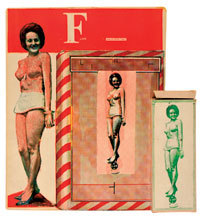 KP Brehmer Aufsteller 13b (Femina neu), 1966 Klischeedruck auf Pappe, kaschiert und gefaltet 27 x 21 x 4 cm Keine Auflage
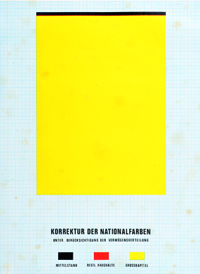 KP Brehmer Korrektur der Nationalfarben, 1970 Offset 28 x 20 cm Auflage: 225.000 Exemplare
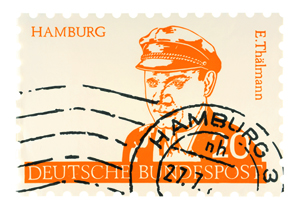 KP Brehmer Jahresgabe f�r den Kunstverein in Hamburg (Th�lmann-Marke), 1971 Linolschnitt auf Offsetpapier, Version II (mit Wellenstempel) 37,5 x 54,5 cm Auflage: 297 Exemplare
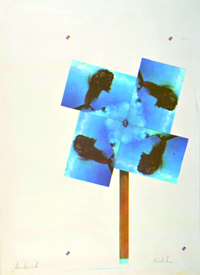 KH H�dicke Propeller, 1970 Siebdruck auf Karton 49 x 35 cm Auflage: 2000 Exemplare
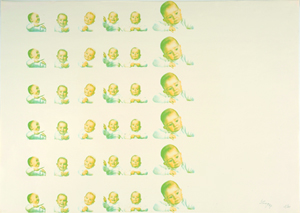 Konrad Lueg Babies, 1967 Siebdruck auf Karton 59 x 83 cm Auflage: 120 Exemplare
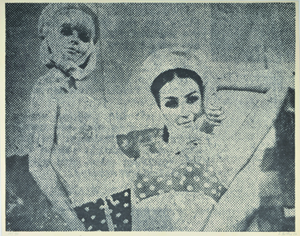 Sigmar Polke Freundinnen, 1967 Offset auf Karton 48 x 61 cm Auflage: 150 Exemplare
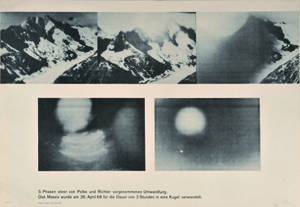 Sigmar Polke / Gerhard Richter Umwandlung, 1968 Offset auf Karton 46,5 x 67,2 cm Auflage: 200 Exemplare
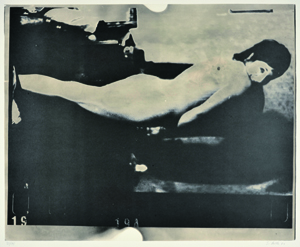 Sigmar Polke Ohne Titel (Weekend III), 1971/72 Offset auf Karton 46,1 x 62,1 cm Auflage: 95 Exemplare
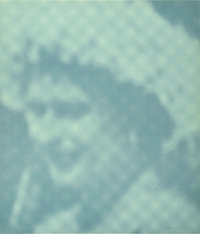 Gerhard Richter Elisbeth II, 1966 Offset 70 x 59,4 cm Auflage: 50 Exemplare
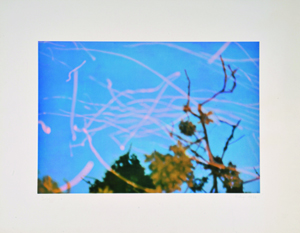 Gerhard Richter Funken, 1970 Offset 49,6 x 64,9 cm Auflage: 200 Exemplare
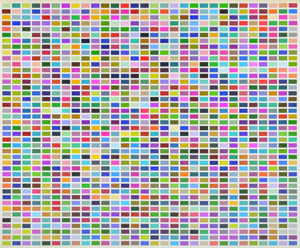 Gerhard Richter Farbfelder Eine von 6 Anordnungen von 1260 Farben, 1974 Offset 64,4 x 79,2 cm Auflage: 32 Exemplare
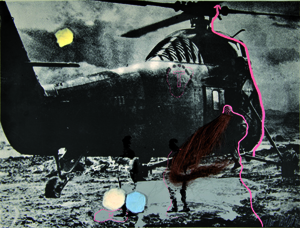 Wolf Vostell Drei Haare und Schatten, 1968 Siebdruck mit roten Haaren und Watte 61 x 81,6 cm Auflage: 90 Exemplare
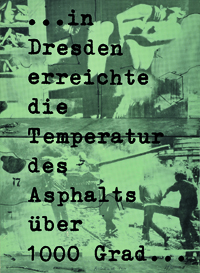 Wolf Vostell Heuschrecken, 1970 Siebdruck auf Karton 65 x 61 cm Auflage: 100 Exemplare |

June 8, 2010 - February 19, 2011
|
Having moved into new and large-scale exhibition spaces in 2008, Edition Block now presents the exhibition 3 "→ ∞" which includes works by Marina Abramovic, Nevin Aladag, Halil Altindere, Maja Bajevic, Henning Christiansen, Danica Dakic, Braco Dimitrijevic, Maria Eichhorn, Ayse Erkmen, Mona Hatoum, Sanja Ivekovic, Sejla Kameric, Gülsün Karamustafa, Jaroslaw Kozlowski, Vlado Martek, Aydan Murtezaoglu, Anri Sala, Bülent Sangar, Sarkis, and Nasan Tur, and presents an overview of the production of the recent years. In the course of the last 40-plus years, Edition Block has constantly moved along new paths in the field of multiplied art and thus written part of art history. To date, it has brought out almost 80 works in collaboration with international artists. All in all, it is a wide-ranging network that has included all the experiences of art in the 1960s, 1970s, 1980s and 1990s, and now with trends in 21st-century art. "PFM-1 and others" (2004) by Ayse Erkmen - the first video installation ever published in an edition - shows on several monitors computerized animations of landmines. In rubber-like, almost organic gestalt they appear from the background, accompagnied by synthetic sounds, and jump into the foreground just to disappear again with a buzzing. By stageing an absurd and bizarre parade the deadly weapons are indeed defused by Erkmen, but still a distressing impression of their deadly force remains. "Bosnian Girl" (2007) by Sejla Kameric results from the preoccupation with an usurping past but at the same time implies something more. Kameric does not regard art as a goal but as a means of self-identification and intermediation. The media and the reality which surrounds her are the points of reference for the artist who grew up in Sarajewo, the city that was besieged by war for more than three and a half years. "Bosnian Girl" is an examination of the tragedy of Srebrenica but also of the phenomenon of country-specific prejudices. The debasing graffiti quoted in this work was written on the wall of a barracks in Srebrenica by an unknown Dutch soldier in 1994/95. The artist Aydan Murtezaoglu deals in her works with the boundaries and structural constraints of Turkish society and how gender roles are formed through family relationships - as well as with possible routes of escape, practices of disobedience and resistance, and gestures of disruption. The motifs of "IN CHARGE" (2009) depict reenactments of situations from the domestic and public spheres. While the artist herself is always one of the central protagonists, her intent is not to resurrect autobiographical incidents. Rather, Murtezaoglu assumes a proxy position and assumes responsibility for examining different aspects of certain role models and the background for their development. Maria Eichhorn's projects constitute an inquiry into the concept of art, the reception and localization of art, the autonomy and authorship of works of art. Her works could be described as investigations at the threshold of the perceptible. Her projects and interventions are often so minimal that they will elude an exhibition visitor's hurried glance. Yet they evoke an ambiguous interplay around perceptual issues - not just sensory perception and concrete experience, but also and most emphatically the perception of politically and socially relevant questions and problems. Maria Eichhorn's projects are often developed in collaboration with colleagues from other disciplines. And they often contain instructions for actions or precise guidelines for implementation, as does the artist's multiple titled "Vier Multiples in Tasche" (2009) [Four Multiples in Bag]. The future owner is challenged to get into the act and complete the work by following various instructions given by the artist. The importance of language and the ties that bind it to culturally coded patterns of understanding as well as the active power of political conceptions are recurrent motifs in Nasan Tur's oeuvre; "City says �" is about the interrelation between language and the public space. Since 2007, the ongoing work has so far been realized in Ljubljana, Berlin, Milan, Belgrade, Stuttgart and Vienna. The artist always begins by collecting hundreds of graffiti from the city he works in, focusing not on the tags left by the sprayer scenes but rather on what are called message graffiti-messages, consisting of individual words or short sentences, that make significant statements. By transposing these graffiti into the context of art, Nasan Tur questions the boundaries separating inside from outside, high culture from subcultures, anonymity from visibility. The formal treatment of these messages, which the artist uses in their entirety without regard for their content, differs from place to place. In Ljubljana, a collection was published on one page in the local daily newspaper, whereas Stuttgart's graffiti were published in an artist's book. In other cities, such as Berlin or Vienna, the artist, in a piece of performance art, sprayed all the slogans he had collected onto one wall of the exhibition space, one on top of the other, so that the result was an impenetrable color field with frayed edges. What the work left behind was a wall painting that represented a compressed version of the city's subtext. This year, Nasan Tur has translated the graffiti from the six cities into color etchings for the portfolio "City says�". The messages have been superimposed by the stylus - in a manner analogous to the spray performances - and appear in the prints in mirror image. The densities and superimpositions are finally indecipherable, though the finely wrought strokes do not completely cover the surface, so that individual words, word fragments, or letters remain legible. Yet the statements stay hidden, lost in the web of lines. The drawing process creates heterogeneous images in which the character of direct address, the sociopolitical relevance and the information contained in the individual messages disappears. Their full significance can no longer be perceived. The image becomes a metaphor for failed - or at least disrupted - communication. |
|
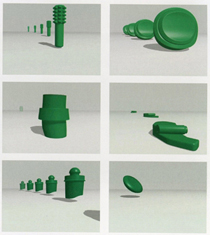 Ayse Erkmen PFM-1 and others 2004
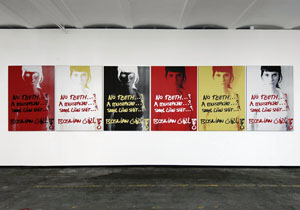 Sejla Kameric Bosnian Girl 2007
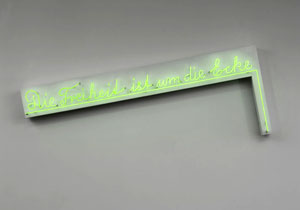 Henning Christiansen Die Freiheit ist um die Ecke 2008
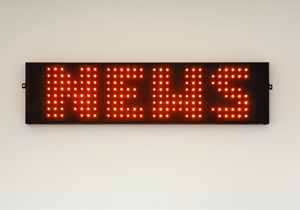 Jaroslaw Kozlowski Rhetorical Figures II 2006
 Maria Eichhorn Vier Multiples in Tasche 2009
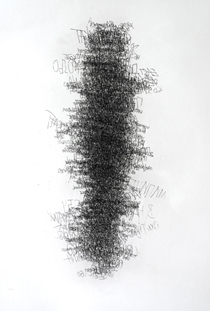 Nasan Tur City says... 2010 (detail) |
BÜLENT SANGAR
ISIMSIZ
March 24 - May 29, 2010
|
In his early photograph series, Bülent Sangar depicted the terror dominating public life in Turkey in the mid-nineties, and the ways in which this political violence was transported and translated into the quotidian life by individuals and the majority of the population. A parallel concern in this period of Sangar´s production was based on the tendencies of homogenisation of daily life, pushing the manifestations promoted by the corporate capitalism towards the miltitaristic spectre. The following works by Sangar problematised both the public and private, and space in the Turkish specificity. In a series of photographs he deals with the conflict-ridden nature of the public, urban realms in metropolitan cities, which are being appropriated and re-signified by the migrated masses, flowing in from the provincial and conservative regions of Anatolia. Parallel to this, his particularised take on the issue of tradition shifted towards domestic environments and using them as a setting for staging tragic moments such as death, murder or sacrifice. The familial space was marked as suffused by both solidarity and a suffocatingly constrictive quality. Recent works of the artist go a step further and raise his doubts about the safety of the household, which in his previous work seemed to function as a shelter, or at least somewhere to return to. Now, the individual is completely isolated, exposed to the fierce forces blitzing from the outside world and reduced to an embryonic state of survival. Figures mostly taken from the fragile and victimised segments of society, such as housewives or female university students, are seen lying on the ground in a curled, self-protective posture as if they were waiting for a natural disaster, perhaps an earthquake, to happen; or trying to hide their faces in front of a judgemental and even criminating camera, combining the brutal police force and the pornographic stare of a corrupted, event-thirsty, post-political and ethic-free mass media.
Erden Kosova In: In the Gorges of the Balkans, exhibition catalogue, Kunsthalle Fridericianum, Kassel 2003 |
|
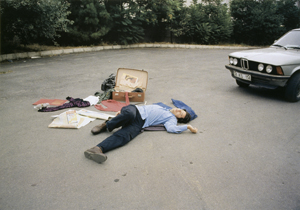 Bülent Sangar ISIMSIZ, 2005 (Detail)
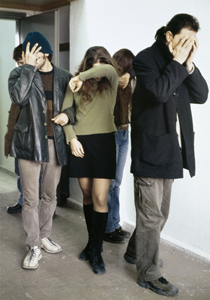 Bülent Sangar ISIMSIZ, 2005 (Detail)
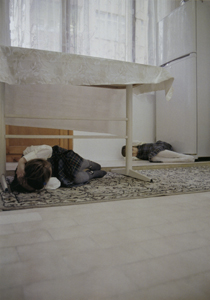 Bülent Sangar ISIMSIZ, 2005 (Detail) |
JAWBREAKER
A VIDEO-MULTIPLE BY EBRU ÖZSECEN
December 15, 2009 � May 29, 2010
| Ebru Özsecen's work stems from research in the fields of architecture and contemporary visual arts. Her work concentrates on different aspects of the psychological and sociological relationship between space and body and on specific environments or locations. Her work covers the range from urban sculpture to strategies of interior and environmental design, from video installation to photography. Her visual and tactile works have taken the form of sound installations, objects, animation, performance, and drawings. Some work is installation in space other is photographic reflex of space or pictorial narration of the history of a given space. The work deals a lot with collective memory. Emerging from this thin steam between inside and outside are dreams, fantasies and longings embodying reflections on society and the individual. The subject matter in her work concerns dualities like public and private, rendering and architecture, figure and abstraction, inside and outside which keep focusing on the individual memory in the contemporary society. Ebru Özsecen investigates the seemingly mundane and exposes it's magical and unseen aspects. She reveals a space where fantasy and memory hide in plain side. Ebru Özsecen tries to capture these "inner wishes via outer spaces." By converting and exploring everyday practices, events and rituals, she addresses the ambivalence of inner and outer space, the opposition between public and private, which has to do not least with social norms and individual fantasy. In a multilayered manner, all of these aspects come together in the work "Jawbreaker", which at the same time reflects strategies of industrial design in multiple productions. | |
 Ebru Özsecen Jawbreaker 2009 (Filmstill) |
AUS AUSTRALIEN
8 GRAPHIC POSITIONS
October 20, 2009 � May 29, 2010
|
In 1988, Edition Block issued Aus Australien, a portfolio of prints consisting of forty sheets by eight Australian artists. The project resulted from curator René Block's interest and involvement in the Australian art scene. As the German coordinator of the Biennale of Sydney in 1984 and 1986, Block was introduced to the local scene, which he later introduced to Berlin in the exhibition Fünf vom Fünften at the daad-Galerie in 1986. A portfolio of prints was already being contemplated at that time and it appeared two years later. In addition to the artists in the exhibition - Richard Dunn, John Lethbridge, Mike Parr, Peter Tyndall and Ken Unsworth - invitations were extended to John Nixon, Vivienne Shark-LeWitt and Jenny Watson. Each created a suite of five sheets in classic techniques of woodcut, etching, stone lithography and silkscreen, which were printed at the Viridian Press in Melbourne.
The portfolio represents a leading generation of artists who brought about major developments in Australian art of the 1970s and '80s. These artists created new alternatives for independent work outside the commercial system and generated increasing critical consciousness in their milieu, thereby also paving the way for a younger generation. Conceptual art and Minimalism formed a common background to this radicalized artistic praxis. Performance, installation and serial art played a significant role in newly structuring the relationship between artists and audience.
The work of Richard Dunn (born 1944) often reflects the social and historical context of artistic production and deals with the complex problem of perception and interpretation. The artist uses paradox, metaphor, codification and contrast between minimal form and complexity of content so that his artworks elude any kind of simplistic interpretation and challenge viewers to enter into an intellectual exchange. Dunn employs eclecticism and changing stylistic orientations as a conscious strategy, while viewing his work as indebted to Minimalism, Supremacist painting and Conceptual Art. Photography, realistic painting, perspective drawing and film montage techniques clash with and relativize each other in his pieces in order to undermine conventional modes of interpretation and ways of seeing.
In the 1970s, John Lethbridge (born 1948) used minimalist strategies to explore the language of art and was interested primarily in self-limiting formal systems. This led him to investigate the polarity of minimal composition and illusionist style, leading to works that bring together formal austerity and intuitive emotionality, the rational and the metaphysical. Lethbridge has developed a formal vocabulary of frontal lines, planes and masses that are used to construct the content of images concerned with the reciprocal attraction and repulsion of bodies, with laws of energy and balance.
Minimalism, the monochrome, Constructivism and readymades are reference points for the work of John Nixon (born 1949), whose work revolves around the contemporary relevance and realizability of the utopian aesthetic and the social and political program of early Modernism. In 1968, the artist set up the Experimental Painting Workshop (EPW), an ongoing project to investigate non-representational painting. Malewich's Black Square, an icon of the self-referential and absolutist idea in painting, and Duchamp, whose readymades transposed everyday objects into the art context, are key points of reference for Nixon. He analyzes the possibilities of monochrome and readymade in laboratory-like project rooms where, building on prior research, he develops them further.
Mike Parr (born 1945) conceives his work chiefly autobiographically and in series, but at the same time considers the problem of audience involvement. While he primarily explored family relations in his early performance pieces, in the 1970s he started to deal with questions of body and space or spatial organization. Since the early 1980s he has developed anamorphic drawings, whose expressive gesture and analytic clarity point to physical and psychological images. Along with performance, the artist uses film, installation, photography, typography, drawings and words to investigate psyche and soma, the interactions between individual and social realms, and the coherence of the self-image.
The works of painter Vivienne Shark-LeWitt (born 1956) deal with domestic life, relations between the sexes, everyday power relationships, trivial mishaps and slightly surreal and poetic phenomena. Humor and references to Catholic iconography, modern literature and art theory characterize her works, which are often executed in small formats or as vignettes. In formal terms, her works are finely painted in oils, in a restrained cartoon-like style that supplies the perfect form for her satirical subjects. While the design is reminiscent of 1950s illustrations, the themes concern a more progressive era where men deal with the housework while women pursue successful careers. Shark-LeWitt's paintings likewise address art-historical questions such as the return to figuration, the impact of advertising and pop culture on art, and the relationship between high and low culture.
Peter Tyndall (born 1951) not only works intentionally in series, he also continually interrogates and reevaluates his own history. He titles every work Detail, A Person Looks At A Work Of Art, someone looks at something, pointing to his preoccupation with the language of art. Each object is only a detail, an effect in a universal web of causes. Tyndall´s pictures consist of series of signs that elaborate the relationship of artwork to viewer, artwork to artwork, and artwork to the cultural context. The symbol that is the key to it all is a square with two parallel lines - an indicator of a possible field of effects and connections. In this way, the artist highlights his pictures' dependence not only on psychic and physical conditions (light, color, frames, hanging) but also on the viewer's presence and the prevailing cultural and historical perceptual praxis.
Ken Unsworth (born 1931) is a sculptor who, starting in the mid-1970s, also began to use his own body in a series of performances in sculptural installations that can be seen in the context of his sculptural oeuvre. These works incorporate recurring basic elements such as steel plates, staves, sticks or river stones arranged in simple, powerful arrays. The artist thematizes the fragility of balance of any kind in a disturbing way: at the precise moment of balance we might become insecure; objects might fall to or lift off the floor. In Unsworth's works, the flawless resolution of formal problems conveyed with clarity and the utmost austerity is always accompanied by doubt and discomfiture as well as dramatic tension.
Jenny Watson (born 1951) works in a figurative mode with a combination of painting, text and objects. Rather than corresponding with what is portrayed, her texts consist of elusive sentences idioms and stories that trigger free associations between image, language and memory. Memorably simple subjects, humor and biting irony characterize her work, which quite intentionally evokes a certain kind of naïveté. Watson's pictures tell complex stories with feminist and socio-critical dimensions. Her art explicitly deals with themes such as female identity, chauvinism and family relationships, but also with mortality, nature and memory.
The portfolio created quite a sensation when it appeared in Australia, for it was the most significant project of its kind as yet realized in that country. It demonstrated that a great number of Australian artists with their own language were vigorously participating in an international dialogue. Moreover, the portfolio evidenced how center and periphery interpenetrate in the cultural context - a theme that publisher René Block would consistently work with in subsequent years.
The portfolio is being presented in Europe for the first time. |
|
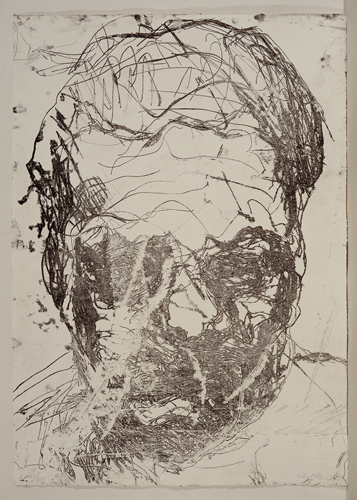
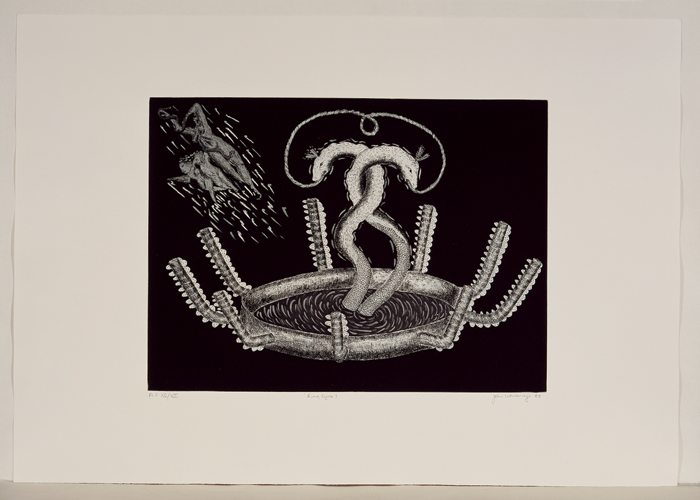 John Lethbridge The Ring Cycle (I - V) 1988
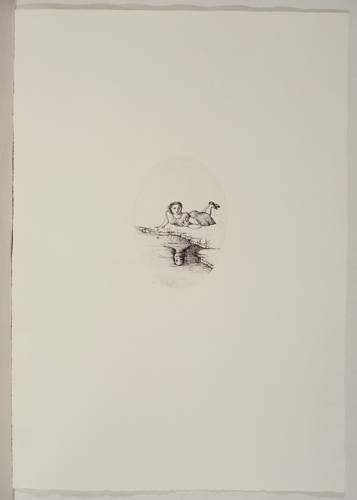
 Mike Parr The Pool of Blood (I - V) 1988
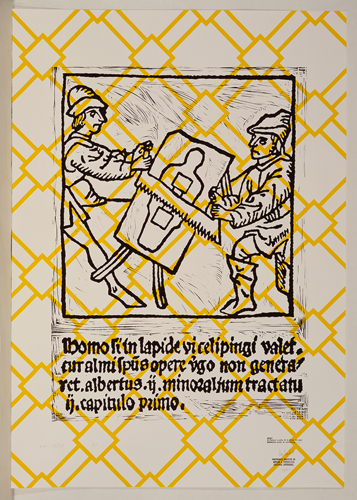
 Vivienne Shark-LeWitt Untitled 1988
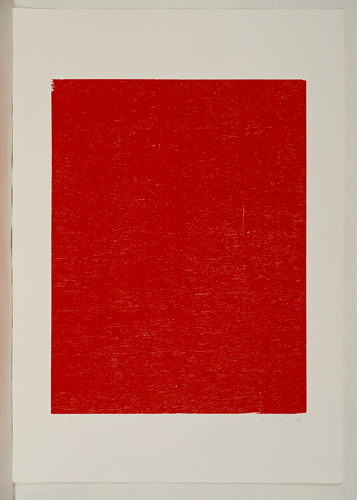
 Peter Tyndall detail: A Person Looks At A Work of Art/someone looks at something... CULTURAL CONSUMPTION PRODUCTION 1988
 John Nixon Self Portrait (Non-Objective Composition) (Purple) (Red) (Brown) (Black) (Ultramarine Blue) 1988
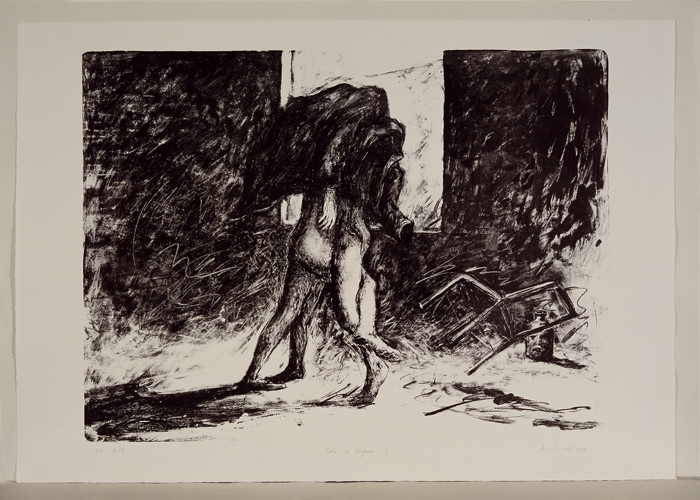 Ken Unsworth Villa des Vergessens (I - V) 1987
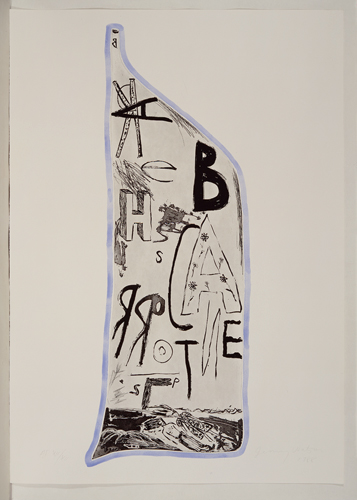 Jenny Watson The Bottled Memories 1 - 5 1988
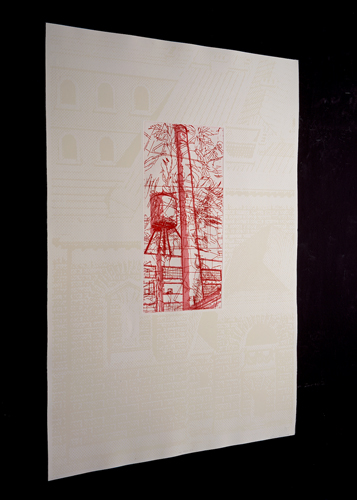 Richard Dunn 100 Blossoms (Five Prisons) 1988 |
MARIA EICHHORN
THE MULTIPLES
May 2 - October 10, 2009
| Maria Eichhorn's projects constitute an inquiry into the concept of art, the reception and localization of art, the autonomy and authorship of works of art. The artist is not interested in resolving formal issues. Her interest instead lies in spheres of activity - her projects develop out of manifold influences and considerations. The exhibition venue is treated not simply as an architectonic space where art is displayed, but in its entire context: who runs it, what happens there, what transpires in its orbit, etc. "I am trying to think more globally. When I visit a place, I try to absorb it in a comprehensive way. A detail could turn out to be important in the end, but the first time I encounter a place, I don't want to go there with any preconceived structures in mind." (Eichhorn) Maria Eichhorn's works could be described as investigations at the threshold of the perceptible. Her projects and interventions are often so minimal that they will elude an exhibition visitor's hurried glance. Yet they evoke an ambiguous interplay around perceptual issues - not just sensory perception and concrete experience, but also and most emphatically the perception of politically and socially relevant questions and problems. Eichhorn directs our attention to perception and to the changing contexts of art. By designing situations where the customary, institutionally configured patterns of perceiving art fail us, she frees up space for seeing and thinking differently. Maria Eichhorn's projects are often developed in collaboration with colleagues from other disciplines. And they often contain instructions for actions or precise guidelines for implementation, as does the artist's new multiple titled Vier Multiples in Tasche [Four Multiples in Bag] now being issued by Edition Block. The future owner is challenged to get into the act and complete the work by following various instructions given by the artist. Edition Block is taking the presentation of this new object in the edition as the occasion to show all of Maria Eichhorn's multiples. | |
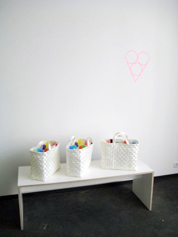 Maria Eichhorn Vier Multiples in Tasche 2009
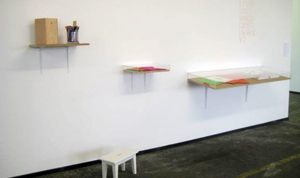 View of the Exhibition |
KP BREHMER / PHILIP CORNER
PICTURES AT AN EXHIBITION
January 3 - October 10, 2009
|
KP BREHMER Pictures at an Exhibition, 1975 In the year 1874 Modest Moussorgsky wrote "Pictures at an Exhibition", inspired by his impressions of an exhibition of watercolors, drawings, architectural sketches and stage designs by the Russian painter and book illustrator Victor Alexandrovich Hartmann. Moussorgsky set ten pictures to music, the cycle of which is held together by an inserted Promenade in variations. The composer did not attempt to make musical illustrations of Hartmann�s work but rather extracted scenic aspects to transform them into musical phantasies. From Moussorgsky�s translations into musical pictures came the impetus for further adaptations and orchestrations. In 1928, for example, Wassily Kandinsky translated the "Pictures" into a stage composition using abstract, kinetic visual forms that came into his mind as he listened to the music. KP Brehmer also translated Moussorgsky�s music back into the visual but used a scientifically generated method. He chose pieces with a length of 4 - 5 seconds from the respective motifs which were then translated into a sonagram at the Institute for Communication Studies at the Technical University in Berlin. The Promenades, the recurring motif that unites the individual pictures, were left out. Brehmer transferred these sonagrams onto etching plates and copied in the titles which are identical with those of the ten pictures set to music. Brehmer�s visualisation of soundwaves has a fundamentally different significance than Moussorgsky�s musical realism or Kandinsky�s idea of a synthetic art. It can be interpreted as pure research into one of the ways the known world can be measured by technical apparatus. To this end, Brehmer presents not simply a single translation of a new form of reality, but sets into operation a process of organization. PHILIP CORNERPictures of Pictures from Pictures of Pictures, 1977/79 From this ongoing process there came into being a new musical development by the American composer and pianist Philip Corner. To each of his ten piano pieces, which, like Brehmer�s bear the same titles as Moussorgsky�s musical pictures, Corner has given an equal frame of time, 5 minutes, virtually a transference from the format of the graphics. The choice of cluster and tremolo as underlying musical structure achieves an equivalent for the texture of concentrated or wavering blackness of line in the visualised duration of sound. Vertical, spatial formations are translated into the ambit of pitch, horizontal relationships into duration of the continous or interrupted prelongation into regulation of tempo, massivity into dynamic delivery. References to the original musical version arise through a minmal adoption of musical material. The reduction to simple, but fundamental material sets the imagination free, heightens it into an unexpectedly new kind of work which combines very unusual, repetitive procedures with complexly worked out sound structures. The score, in form of a first sketch, makes the composers� working procedure visible. The notation is not meant to be followed while listening. It brings subjective moments into play that give the reader the role of a deciphering sleuth. Its colorful mixture of writing, notes and drawing turns it into a graphic work that adds a new picture to the mu |
|
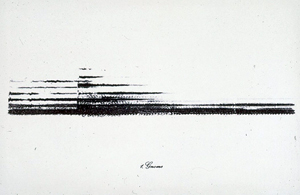 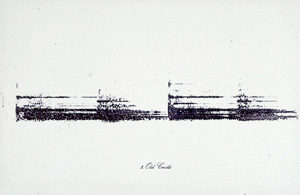 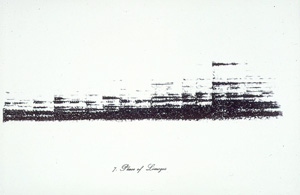 KP Brehmer aus der Serie Bilder einer Ausstellung 1975 |
AYDAN MURTEZAOGLU
IN CHARGE
May 2 - May 30, 2009
| The artist Aydan Murtezaoglu deals in her works with the boundaries and structural constraints of Turkish society and how gender roles are formed through family relationships - as well as with possible routes of escape, practices of disobedience and resistance, and gestures of disruption. She articulates these issues via a "perspective from within" that problematizes the artist's claim to an external position as critic of the culture s/he inhabits. The artist searches for ways to express her own embeddedness in the social structure and to articulate her responsibilities toward the social surroundings in which she is also involved as an artist. Aydan Murtezaoglu formulates these same concerns in the eight offset lithographs comprising IN CHARGE, the portfolio now being published by Edition Block. The motifs, based on her photographs, depict reenactments of situations from the domestic and public spheres. While the artist herself is always one of the central protagonists, her intent is not to resurrect autobiographical incidents. Rather, Murtezaoglu assumes a proxy position, slips into a role in order to illuminate as many of its facets as possible. The artist is "in charge" in the sense that she assumes responsibility for examining different aspects of certain role models and the background for their development. Yet she eschews an emotional or accusatory critical stance. Instead she is concerned with differentiations: what similarities exist, what bonds us, what separates. Aydan Murtezaoglu's investigation of social reality brings to light equivocal factors and ambiguities that disclose new, open-ended avenues of reflection. This edition is published on the occasion of the joint exhibition by Aydan Murtezaoglu and B�lent Sangar: UNEMPLOYED EMPLOYEES - i found you a new job! in the Tanas project space. | |
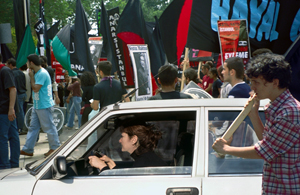 Aydan Murtezaoglu IN CHARGE 2009 (Detail) |
ICH KENNE KEIN WEEKEND
Beuys & Block: the joint editions 1966 - 1986
October 2, 2008 - March 31, 2009
| The media of the multiplied object was of central meaning for Joseph Beuys because the sociological and economical aspects of his artistic idea found a suitable form within this context. Beuys was interested not only in the serial character, above all he was convinced by the possibilities of this media as a carrier of ideas and a media of communication. The meaning and form of the multiplied object was radically extended by Beuys. In the course of his artistic career he created more than five hundred multiples, mostly using photographs of his own actions, but also working with original prints and objects. Beuys created his first multiples in the 1960ies on invitation and suggestion of Ren� Block. Significant works such as "Schlitten", "Filzanzug", "Silberbesen" or "Das Schweigen" were then published together with Edition Block. The exhibition now presents some of these joint editions, in parallel to the retrospective of Joseph Beuys at Hamburger Bahnhof. | |
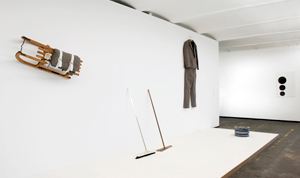 View of the Exhibition |
TO BE CONTINUED
March 8 - July 26, 2008
| The first presentation of Edition Block, "to be continued", shows new multiples by John Cage, Henning Christiansen, AySe Erkmen, Sejla Kameric, Jaroslaw Kozlowski, Olaf Metzel, B�lent Sangar, Carlos Santos et al. as well as some exclusive editions of the past decades. With this presentation and the continuation of it�s work Edition Block deliberately takes up the tradition of the non-established: The first video multiple ever, which was edited in the 1970ies with Nam June Paik, is now followed by the first video installation in an edition of twelve copies with the Turkish artist Ayse Erkmen. Erkmen�s video installation "PFM-1 and others" (2004) was published by Edition Block as a multiple and shows on several monitors computerized simulations of landmines. In rubber-like, almost organic gestalt they appear from the background, accompagnied by synthetic sounds, and jump into the foreground just to disappear again with a buzzing. By stageing an absurd and bizarre parade the deadly weapons are indeed defused by Erkmen, but still a distressing impression of their deadly force remains. The multiple "Bosnian Girl" (2007) by Sejla Kameric also results from the preoccupation with an usurping past but at the same time implies something more. Kameric does not regard art as a goal but as a means of self-identification and intermediation. The media and the reality which surrounds her are the points of reference for the artist who grew up in Sarajewo, the city that was besieged by war for more than three and a half years. "Bosnian Girl" is an examination of the tragedy of Srebrenica but also of the phenomenon of country-specific prejudices. The debasing graffiti quoted in this work was written on the wall of a barracks in Srebrenica by an unknown Dutch soldier in 1994/95. "Das wohlpr�parierte Klavier" (2008) by Carlos Santos presents itself closely related to the body but with a completely different approach. The artist, a cross-border commuter between art and music, treats the keyboards of pianos and in so doing visualizes the erotically-tactile moment typical for his piano playing. Using musical means and performative physical exertion Santos attempts with his compositions to uncover a fundamental energy and to break up traditional means of expression. With surreal wit and post-dadaistic onomatopoeia he takes the human voice to her limits - drastically, erotically and obsessively. | |
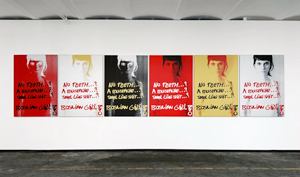 �ejla Kameric Bosnian Girl 2007 |
