Blinky Palermo
Blaues Dreieck
1969
EB21
Stencil drawing on paper, stencil made of hard cardboard, brush, paint, instructions in cardboard (50 x 70 x 2 cm)
Edition of 50, drawing signed
out of stock

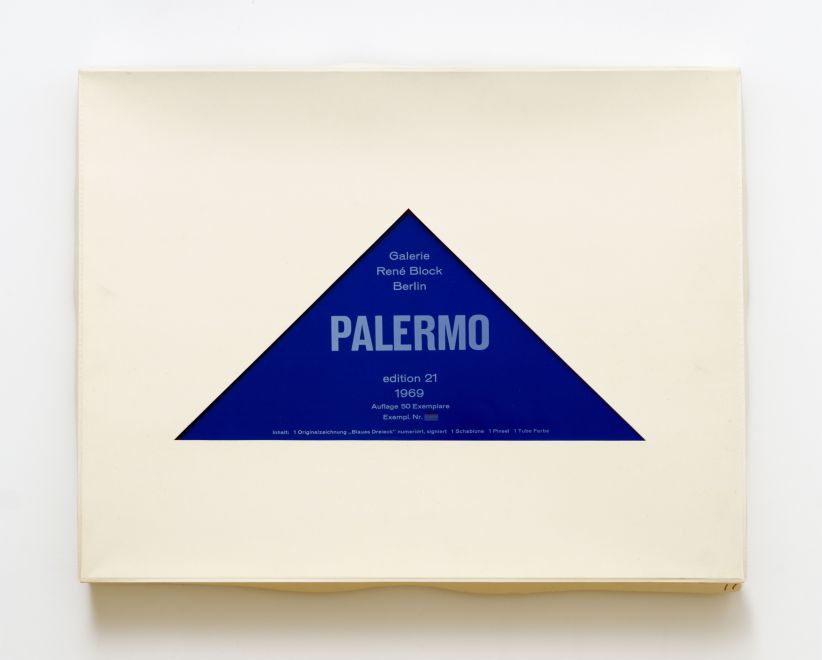
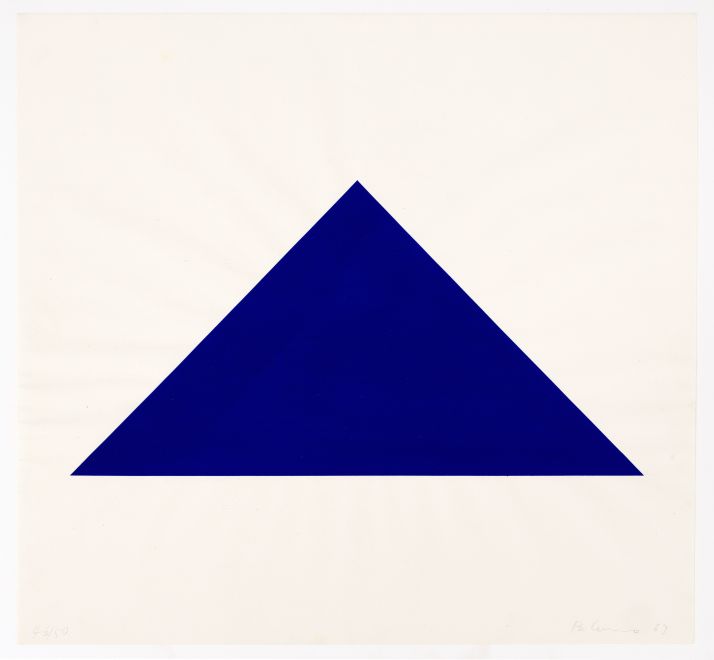
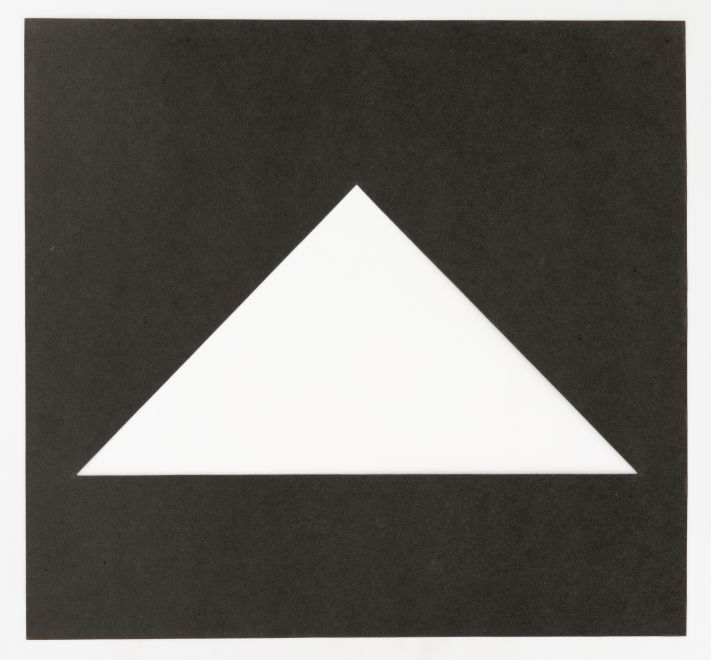
“Paint a blue triangle above a door using the template. Then give away the original sheet. Palermo, August 1969”—these are the instructions Palermo designed for the limited edition object Blaues Dreieck (Blue Triangle). In addition to the instructions, a simple stapled cardboard box contains the tools needed to carry out the task: a sturdy stencil made of dark, gray-green cardboard, a small flat bristle brush, a small tube of blue tempera paint (ultramarine dark 442 from Schmincke), and an original sheet of Blaues Dreieck, which Palermo created and signed using the cardboard stencil. The black template shows signs of use from blue paint. A triangle has been cut out of the lid of the box and lined with a blue sheet. On this sheet, the publisher’s details and numbering are printed in white letters, the artist’s name in large type, and a list of the contents of the box, arranged so that they can be read through the cut-out triangle in the lid.
“Perhaps it would be a good idea if I came to Berlin in the middle of the month and made the original sheets using the respective template. (So that the original sheet in each box would be painted with the corresponding template. This template would therefore already have been used),” Palermo wrote to the gallery owner at the beginning of September, enclosing a sketch of the planned box with his letter.1
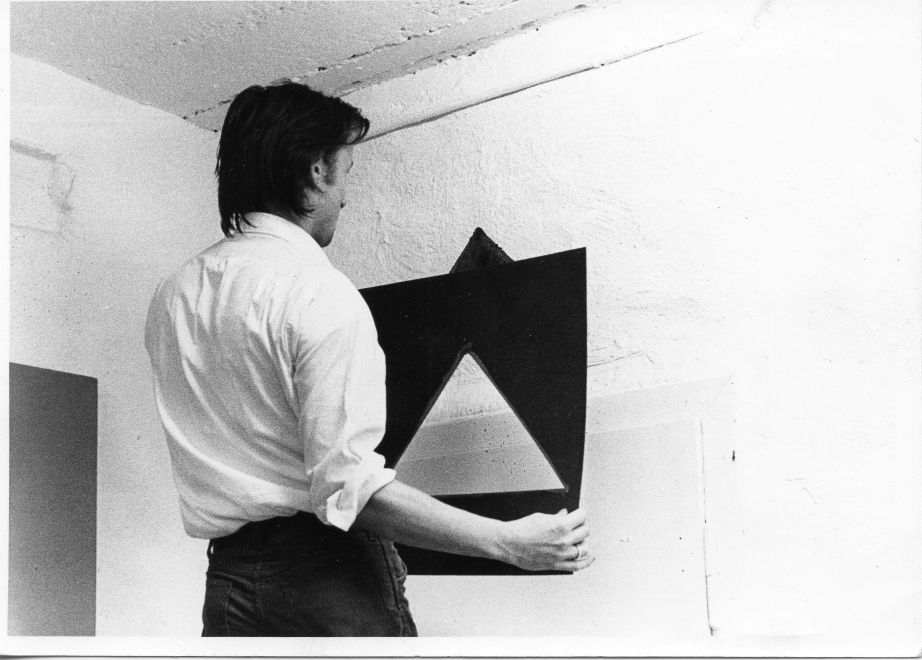
As early as 1966, Palermo had created Blaues Dreieck as a two-color screen print in an unknown edition; in the same year as the edition described above, Blaues Dreieck was published in a planned edition of 20 copies by the Ernst Gallery Edition in Hannover, consisting of a triangular chipboard panel painted over with blue poster paint.2 Unlike these two editions, Blaues Dreieck from Edition Block comes with instructions for use. These instruct the recipient to give away Palermo’s original sheet after completing the triangle themselves. Palermo himself demonstrates how the triangle should be made and placed. A series of photographs published in a sheet of the Edition Block ring binder shows the artist attaching the triangle above a door in Gerhard Richter’s studio.
Text: Birgit Eusterschulte
1 Blinky Palermo to René Block, Letter from September 1,1969, Archive René Block.
2 Cf. Blinky Palermo. Die gesamten Editionen. The Complete Editions, ed. by. Julia Friedrich, Museum Ludwig, Köln; Verlag der Buchhandlung Walter König, Köln 2020, p. 30ff., p. 38ff., p. 44ff.