Roman Opalka
1965/1-∞
1977
EB43
LP
Edition of 400
out of stock
The French-Polish artist Roman Opalka was a guest of the DAAD Artists-in-Berlin Program in 1976. In January of the following year, Galerie Block, in collaboration with the Artists-in-Berlin Program, presented the exhibition Roman Opalka. 5 Details from 1965/ 1– ∞ with paintings by the artist created in Berlin. A report in the Berlin Tagesspiegel in January 1977 describes the exhibition situation as follows: “From the tape recorder, one hears regular words, incomprehensible, a litany, as if recorded during a foreign church service. These are numbers, in Polish, the same ones that appear—close together—on the three canvases in the same room. The painter pronounced them as he wrote them down, and now they run before the pictures, a reminder that it is not or not only the result, the picture, that counts, but above all the process. In a unique case in art history, a painter has imposed a very strict law on himself, and he has been working and living according to it for twelve years now.”1
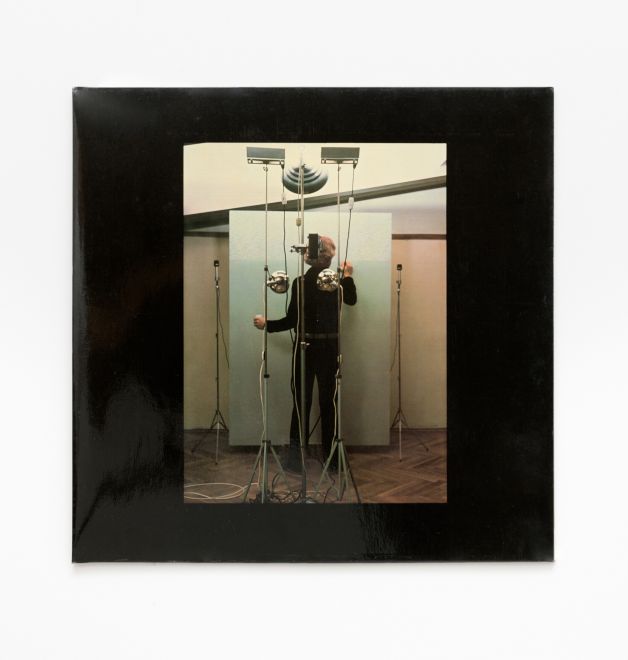
The record 1965/1–∞, released in 1977 by Edition Block, reproduces the spoken numbers of two Details from this exhibition: an excerpt of just over 22 minutes from the count from 1,987, 108 to 2,010,495 on the A-side and an excerpt of just under 21 minutes from the count from 2,136,352 to 2,154,452 on the B-side. The rhythm of the evenly and slowly spoken count changes audibly at the threshold from one to two million. The artist explains the “strict law” referred to by the Tagesspiegel critic in a short text on the record: “In my approach, which is a program for my life, the working process is recorded through a progression that both documents and defines time. The only date that appears is the date of creation of the first Detail, 1965, before the infinity sign and the first and last numbers of the given Detail. / I count continuously from 1 to infinity on details of the same image format (except for the Reisezeichnungen (Travel drawings)) by hand with a brush, using white paint on a gray background, which will have 1% more white on each subsequent Detail than on the previous one. Consequently, I await the moment when Details appear white on white. / Each Detail is accompanied by a phonetic recording on tape and a photographic image of my face.” The cover of the record released in the edition also shows a photo of the work setup. It shows the artist writing in front of a large, portrait-format canvas (195 × 135 cm), surrounded by equipment for lighting, sound recording of the spoken numbers, and a camera. He has his back to us. When this Detail is complete, he will turn around and take a portrait of his face.
Text: Birgit Eusterschulte
1 Heinz Ohff, »Die Kunst der Askese. Roman Opalka in der Galerie Block«, in: Der Tagesspiegel (January 26, 1977).