Nam June Paik
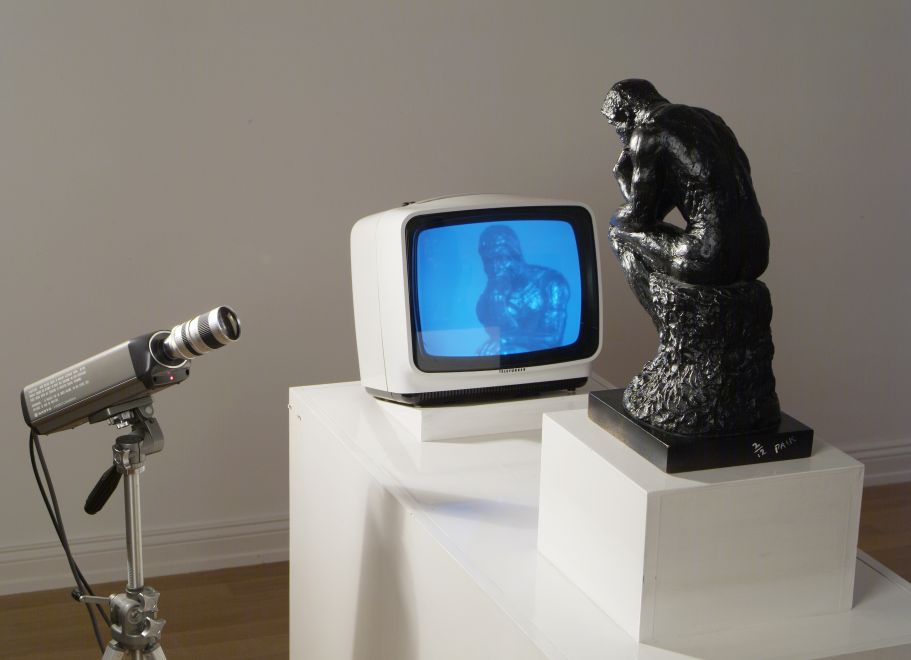
Der Denker (The Thinker)
1976/78
EB47
Sculpture after Rodin, plastic, video camera, tripod, television set, white lacquered wooden pedestal
Height of the object: 135 cm. Pedestal in closed condition 70 x 50 x 110 cm
Edition of 12 + 2 AP, signed and numbered
out of stock
“The most elaborate piece in the show is entitled Video Buddha” a New York critic writes about Nam June Paik’s solo exhibition Paper TV and Video Buddha 1975 at the René Block Gallery in New York in the Soho Weekly News. “Here, Paik has placed a seated Buddha sculpture before a television screen, which picks up and reflects the Buddha’s image. It is an experiment in electronic contemplation – an electronic submersion in Zen – an incongruous and ironic comment on the basic of futility of ‘loosing oneself‘.”1
The concept behind the limited edition object Der Denker (The Thinker) ties in with the video sculpture Video Buddha, created two years earlier, but replaces the Buddha with a miniature replica of Auguste Rodin’s famous sculpture The Thinker, made of plastic. It is Paik’s first limited edition object in collaboration with René Block, whose gallery program had already featured the artist in June 1965 with the performance of Robot Opera (1964) with a self-built, remote-controlled robot at the Brandenburg Gate and the Gedächtniskirche in Berlin as part of a Fluxus soirée. Exhibitions followed, primarily at the New York gallery. In New York, Paik and Block also happen to find several copies of a miniature of the Rodin sculpture in a general store south of 14th Street in Manhattan – fortunately, because producing this replica themselves had proven to be very time-consuming and expensive. The idea of using The Thinker for a limited edition object in a closed-circuit video process arose because, after the sale of the video sculpture TV Buddha to the Stedelijk Museum Amsterdam, it could no longer be produced in limited editions, as agreed with director Edy de Wilde. Unlike the Buddha figure, which stands facing the camera and monitor and also produces a closed circuit via the lines of sight, Rodin’s contemplative figure tilts his head slightly to one side. The video camera positioned to the side captures the thinker’s gaze, but he appears to be turned away from the monitor and does not seem to notice the image being recorded and shown in real time.
In addition to the sculpture, the edition includes all the technical equipment needed to set up the installation. All components – the sculpture after Rodin, video camera, tripod, television set – are stored in a white-painted wooden box, which can also be used as a pedestal for presenting the edition. To ensure correct installation, it is equipped with a slant for the monitor and a small pedestal for the sculpture. As one of the pioneers of video art, Paik is also at the cutting edge of technical possibilities with the production of the edition Der Denker.
Text: Birgit Eusterschulte
1 John Gruen, »Video, Sculpture, Still Life«, in: Soho Weekly News (Februar 13, 1975).