Konrad Lueg
Würfel
1967
EB6
Inflatable, color-printed plastic foil
60 x 60 x 60 cm
Edition of 30
out of stock

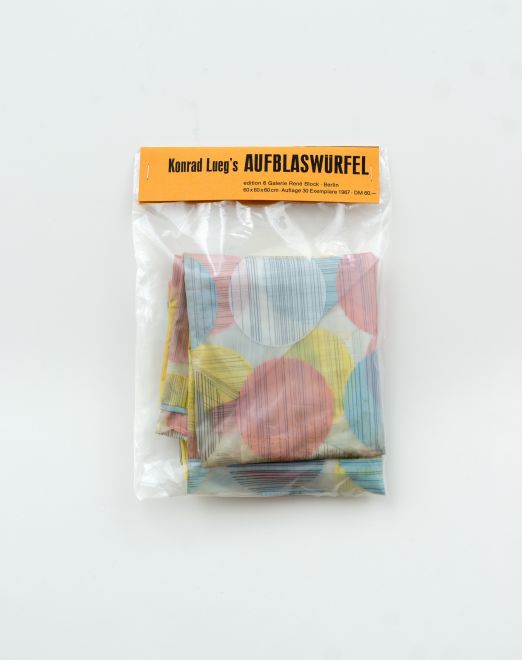
“ Konrad Lueg’s Aufblaswürfel” (Konrad Lueg’s Inflatable Cube) as edition No. 6 is called on a label accompanying the multiple, was created in the context of the artist’s second solo exhibition, Würfel und deutsche Muster (Cubes and German Patterns), in November 1967 at Galerie Block, where Lueg showed canvases with prefabricated pattern foils. The inflatable cube, made of plastic foil, is printed with a serial colored dot pattern. Würfel is offered for sale folded up in a small plastic bag. A paper tab, which serves as the bag’s closure, bears the title and further information about the edition, as well as the price and instructions for use. The object Würfel appears like a conventional product from the realm of everyday consumer goods.
Lueg’s paintings from the 1960s, his exploration of wallpaper and fabric patterns and other decorative elements of everyday culture, but also motifs from sports such as soccer players and boxers, which Lueg had already used in the opening exhibition of the Galerie Block, Neodada, Pop, Décollage, Kapitalistischer Realismus, in 1964, are clearly inspired by American Pop Art, such as that of Roy Liechtenstein, but follow their own unique path of German Pop Art. Together with Gerhard Richter, whom he had met at the Düsseldorf Art Academy, Lueg organized the now legendary performance Leben mit Pop – eine Demonstration für den kapitalistischen Realismus (Living with Pop – a demonstration for capitalist realism) at the Berges furniture store in Wuppertal in 1963 and thus coined the term that the Galerie Block would also use to describe an ironically critical approach to the artistic examination of social, political, and aesthetic phenomena in a consumer-oriented, capitalist present. In this sense, Lueg’s edition Würfel, in the form of an inflatable plastic object made of “modern” material, with serial decoration and downright banal utility (e.g., as a decorative object in a pool), is representative of the precise observation of German consumer culture. The same applies to Lueg’s contribution to the graphic portfolio Grafik des kapitalistischen Realismus (EB25), which was also created in 1967. 1967 is also the year in which the artist, under his birth name Konrad Fischer, opened his own gallery in Düsseldorf together with Dorothee Fischer and gradually ceased his activities as an artist.
Text: Birgit Eusterschulte