Joseph Beuys
… aus dem Maschinenraum
1977/78
EB44
Glass (height 14 cm, diameter 11 cm) with fat, tin (height 12 cm, diameter 10 cm) with honey
Edition of 12 + 4 AP, signed and numbered
out of stock

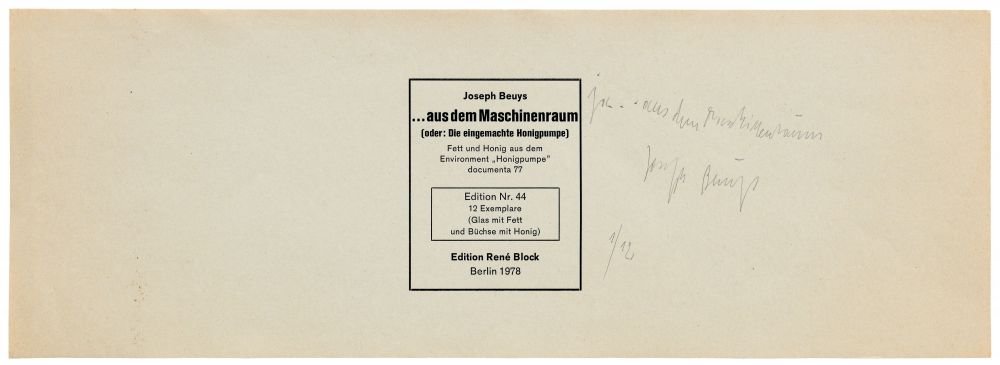
The two-part edition … aus dem Maschinenraum (… from the engine room) consists of a preserving jar filled with fat and a tin can with honey. The title is to be understood literally, as the fat and honey come – as can be read on the paper banderole of the metal can – from the installation Honigpumpe am Arbeitsplatz (Honey Pump at the Workplace) developed by Beuys for documenta 6 in 1977. The “engine room” of this installation was housed in the centrally located rotunda of the Museum Fridericianum. From here, a complex machine, consisting of a pump and a copper roller rotating on grease with two motors, kept diluted honey in motion, which circulated in a circulation system of hoses and pipes over the entire height of the surrounding staircase. During documenta 6, Beuys juxtaposed the physical circulation with a multi-layered symbolic content for ecological and social contexts with the circulation of ideas in the form of workshops and seminars at the FIU (Free International University), in which he discussed socially relevant topics with visitors over a period of 100 days in the immediate vicinity of the Honigpumpe am Arbeitsplatz. “I wanted to create a workplace,” Beuys explains the connection between the installation and FIU’s activities, ”where it becomes visible how the expanded concept of art works, that is, how it differs as an expanded concept of art from the traditional concept of art and what it refers to.”
The edition … aus dem Maschinenraum was created during the dismantling of the documenta work, whose complex realization had already been accompanied by René Block and his father. The latter, a trained armature winder, realized the construction of the copper roller with the two counter-rotating motors and the pump system. Beuys, who was interested in the elements and processes of craft workshops at this time, had previously taken over the entire electrical workshop, which Werner Block had largely built himself, after it had been abandoned. A replica of an impregnation system developed by him for impregnating motors can be found as the central element of the Honigpumpe am Arbeitsplatz in the form of a stainless steel vat from which the liquid honey is pumped into the circulation system.
As if to confirm its origin from the documenta work, the paper banderole of the metal box, on which the title and details of the edition can be found, bears the addition “ ja … aus dem Maschinenraum” (yes … from the engine room) handwritten by Beuys. The edition is also signed and numbered by Beuys in pencil on the banderole of the tin. The central elements of the installation – honey and fat as materials that stand for energetic and transformative processes in Beuys’ work – are preserved as relics of the mental and physical activities of the Honigpumpe am Arbeitsplatz. Their use there has left traces in the material. In particular, a layer of dust had settled on the fat during the 100 days in the machine room, which can be seen as a sedimentation of the mental and physical processes. Fat from the documenta work is also incorporated into two independent objects. For Zur Honigpumpe (1977), Beuys places two bricks of margarine in a cardboard box; in Aus dem Maschinenraum, Anhänger (1977), the fat is filled into two margarine boxes together with small rolls of felt.
Text: Birgit Eusterschulte
1 »Videointerview. Karl Oskar Blase – Joseph Beuys«, in: Veit Loers, Pia Witzmann (ed.), Joseph Beuys. Documenta-Arbeit, Exhib. cat., Museum Fridericianum Kassel, Stuttgart 1993, p. 169–176, here p. 169.