Weekend
1971/1972
EB32
Suitcase with an object by Joseph Beuys and 19 prints by KP Brehmer, K.H. Hödicke, Peter Hutchinson, Arthur Köpcke, Sigmar Polke and Wolf Vostell
Case: 50 x 64 x 6 cm
Of the planned edition of 95, around 65 were realized in the suitcase, all contributions are signed, the prints are numbered
price for the entire suitcase on request
selected contributions available individually
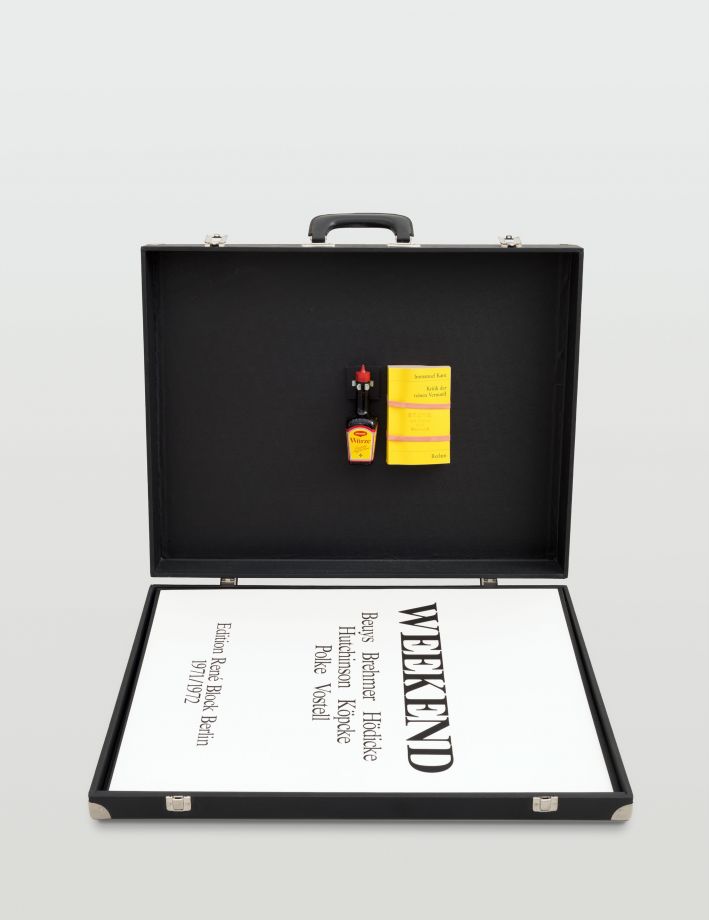
The Weekend suitcase is designed as a transportable selection of prints. The suitcase, which was produced especially for the edition Weekend, follows the idea of “taking an additional suitcase with you on business or vacation trips, containing a selection of artworks that you could surround yourself with in your hotel room or weekend home”.1
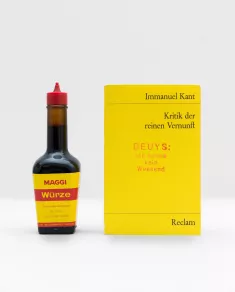
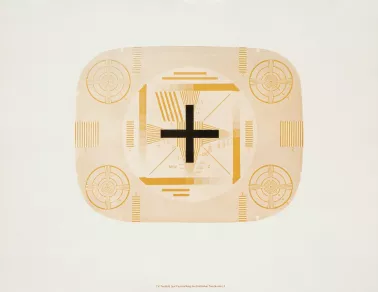
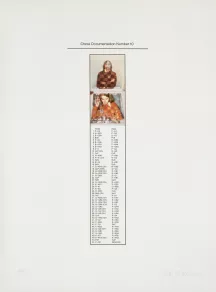
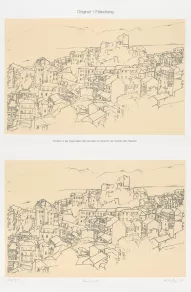
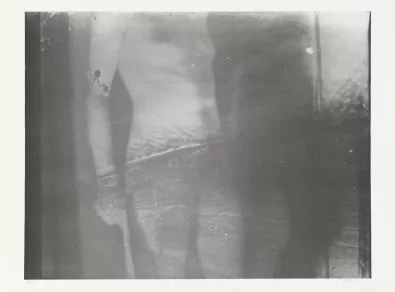
The selection for the weekend includes contributions by Joseph Beuys, KP Brehmer, K.H. Hödicke, Peter Hutchinson, Arthur Köpcke, Sigmar Polke and Wolf Vostell, who have been invited to develop small print series for the Weekend suitcase. With the title Ich kenne kein Weekend, Beuys responds directly to the concept of the edition. For his contribution in the form of a readymade, he stamped “BEUYS: ich kenne kein Weekend” on a Reclam edition of Kant’s Kritik der reinen Vernunft (Critique of Pure Reason) and combined it with a standard Maggi bottle. Both objects are attached to the lid of the suitcase, the Maggi bottle with a metal clip on the neck of the bottle, the book with two wide rubber bands. The object can be shown in the open case. The series of prints by Brehmer, Hödicke, Hutchinson, Köpcke, Polke and Vostell, which are housed in compartments of the suitcase, can also be understood as a humorous, ironic or sarcastic commentary on the weekend: Brehmer and Vostell address television consumption including political infiltration, Hödicke develops a series of seek-and-find images and Hutchinson deals with the game of chess, Köpcke with the idea of the vacation home and finally Polke pursues private weekend pleasures.
The contributions by various artists collected in the Weekend suitcase once again demonstrate what interested the gallery owner René Block at the beginning of the 1960s about the awakening of a young generation of artists: an ironic-provocative practice that, based on a precise observation of everyday life, mass consumption and the media, exposes social and political reality and sometimes reflects and comments on it with humorous profundity. At the beginning of the 1970s, the title can hardly be read without thinking of Jean-Luc Godard’s sarcastic satire of bourgeois life in the film Week End (1967) and the radical aesthetic experiments of his film language. Inevitably, however, the concept of the suitcase also evokes the memory of Marcel Duchamp’s Boîte-en-valise (1935-41) and thus ties in with the historical avant-gardes as an important reference for a politicized neo-avant-garde. While Duchamp’s museum collects his own works in miniature in the box, Block’s Weekend suitcase shows a small cross-section of the artists associated with his gallery in the early 1970s. It is thus close to the Fluxus artists’ practice of putting together edition objects in boxes and crates for distribution. One example is George Maciunas’ Fluxkit (1964), a briefcase containing small objects, scores and other editions by various Fluxus artists as a collective ensemble.
Of the 95 planned pieces of the case, around 65 were produced. The title, artists’ names and publisher are listed on an endpaper. The first exemplars had a tag with the title and publisher of the edition on the handle of the case. The 18 prints in the case (lithographs, screen and offset prints) are signed and numbered. The cases were produced on request. As a result, a Maggi bottle with a different manufacturer’s label is used in exemplars from 1980 in Beuys’ contribution; from 1986, Wenzel Beuys signed the Reclam book in the imprint; it also bears an estate stamp from the Beuys Estate.
Text: Birgit Eusterschulte
1 »›Ich tue ja manches für die Kunst, aber betteln will ich nicht.‹ Martin Glaser im Gespräch mit René Block«, in: Quartett. Vier Biennalen im Spiegel grafischer Blätter, Berlin: Edition Block, 2008, p. 109.
Works in portfolio
Weekend