En Bloc
1969–1972
EB20
Tambour door cabinet with objects by 19 artists from the René Block Gallery
Version A: 9 drawers, 106 x 45 x 37 cm
Edition of 10
Version B: 14 drawers, 115 x 45 x 39 cm
Edition of 20
price on request
selected contributions available individually


Artists: Joseph Beuys, KP Brehmer, Bazon Brock, Hansjoachim Dietrich, K.H. Hödicke, Imi Giese, Imi Knoebel, Bernd Lohaus, Konrad Lueg, Palermo, Sigmar Polke, Gerhard Richter, Gerhard Rühm, Dieter Roth, Reiner Ruthenbeck, Tomas Schmit, Wolf Vostell, Stefan Wewerka, Lambert Maria Wintersberger
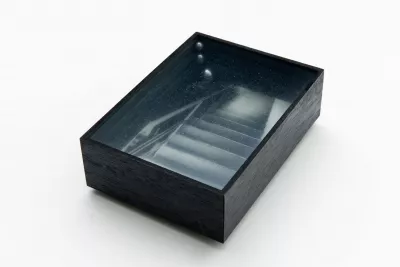
To mark the gallery’s fifth anniversary, René Block has designed the edition En Bloc – a solid wooden tambour door cabinet with drawers containing the works of 19 artists. Those artists living in Germany who have shaped the gallery’s program in its first five years have been invited to develop a limited edition for the cabinet.
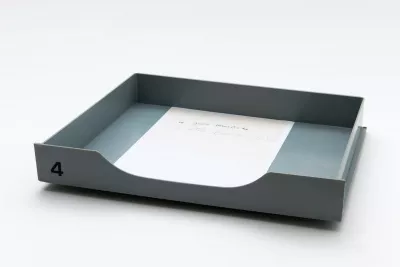
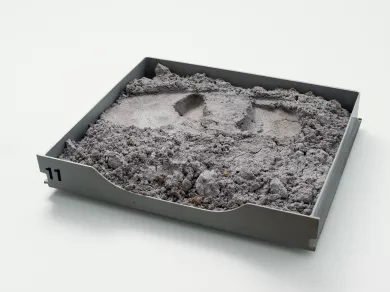
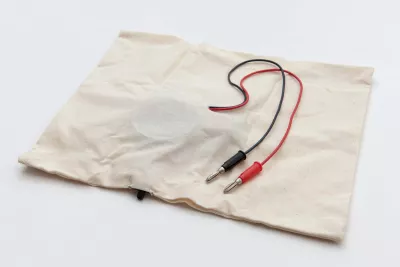
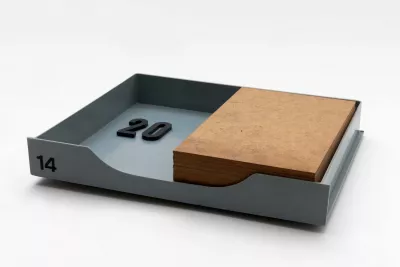
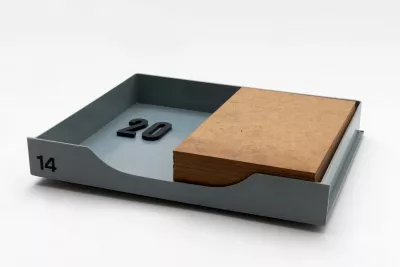
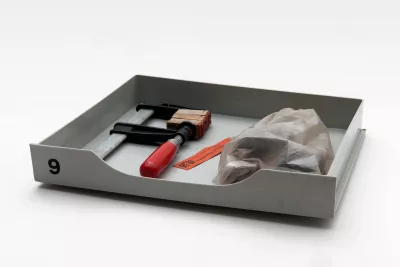
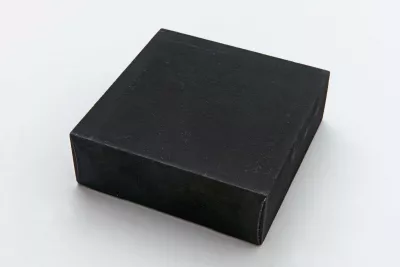
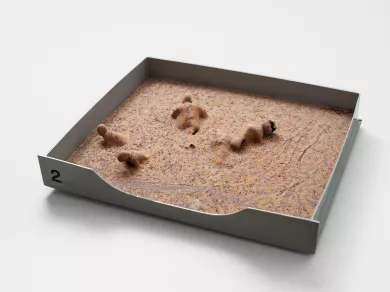
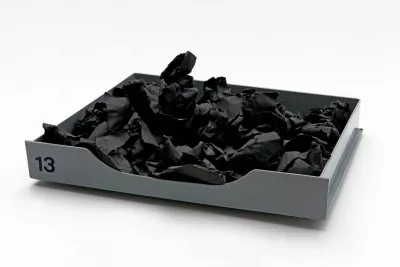
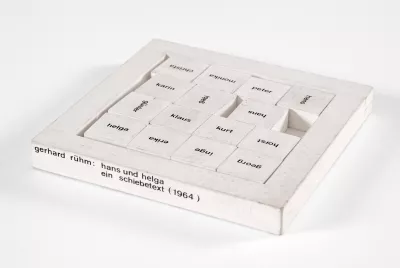
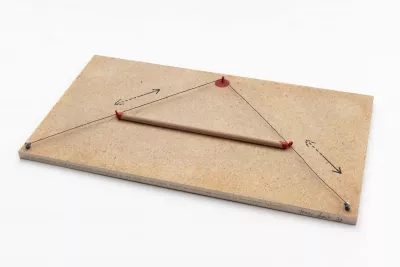
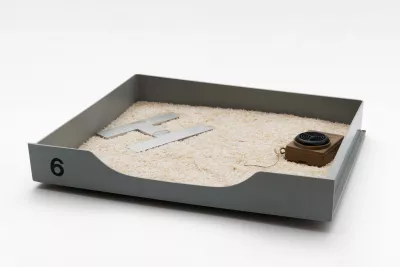
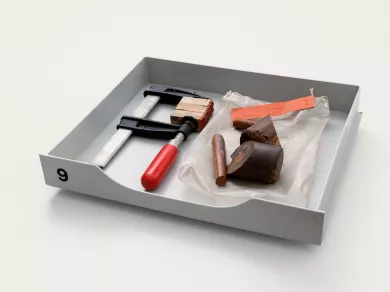
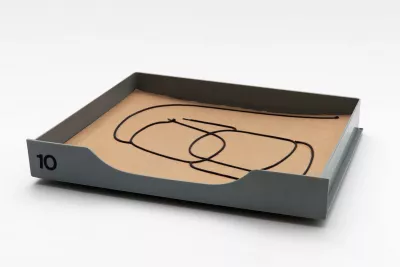
The tambour door cabinet En Bloc is designed in an edition of 30 pieces and is produced in two versions. Version A, a dark cabinet with nine drawers, appeared in a preliminary version in 1969 in an edition of ten, which was completed in 1970; a second version (B) with a slightly larger cabinet made of light wood with 14 drawers was completed in 1972 in an edition of 20. The edition changes the cabinet model, as the version A cabinet is no longer commercially available in 1972. The slightly smaller version A is offered to the participating artists as a proof. Both versions contain all 19 contributions and are sprayed with the title, edition number and the names of the participating artists on the front of the cabinet’s roller shutter using a stencil: “beuys brehmer brock dietrich hödicke imi-giese imi-knoebel lohaus lueg palermo polke richter ruehm rot ruthenbeck schmit vostell wewerka wintersberger”. The gray plastic drawers of version B are numbered with black numerals. The artists’ approach to the given framework of the drawer is quite different: while some, such as Dieter Roth, Wolf Vostell or Bazon Brock, incorporate their contributions directly into the drawers and these editions can only be shown with the drawer, others, such as Gerhard Richter, Gerhard Rühm or KP Brehmer, develop objects that can be removed from the drawer for use or viewing. In Gulo borealis, Joseph Beuys takes the bureaucratic framework of a flat file cabinet particularly literally in that he places a sheet of paper written in pencil and ink with the eponymous term in the drawer. Bazon Brock is quite different, making the drawer part of an action in the gallery: He sets them up in a row, pours concrete over them and walks from drawer to drawer, leaving an imprint of his shoe in each case.
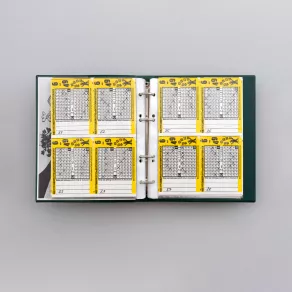
A metal ring binder is screwed into the top drawer of version B, into which documentation is bound. The biographies of the participating artists up to 1972 and original portrait photos by Jürgen Müller-Schneck are contained on copied sheets in transparent plastic covers in A4 format.
Version A of the tambour door cabinet En Bloc was presented for the first time at the Cologne art market in 1969. The critic of the Frankfurter Allgemeine Zeitung was full of enthusiasm: “The Berlin gallery Block is the liveliest (and probably the most social in terms of the range of favorable offers), full of ideas of its very own character: There is, for example, a trolley cabinet ‘en bloc’; if you open it, you pull out a different world of artists from each of the 17 [sic!] Hödicke places alarm clocks and stamps in the tar, Vostell brings a radar siren into contact with a generous portion of spaghetti [sic!].”1
With the completion of version B, the En Bloc tambour door cabinet was also presented at the Galerie Block stand during the 4th International Spring Fair in Berlin in 1972. This edition of the Berlin fair, which was organized by René Block as a fair for multiplied art, was a particular concern of the gallery owner, who saw the p. democratization of art made possible by the presentation of multiples.2 “As far as his own gallery is concerned, he does a lot to undermine official concepts of art,” the Frankfurter Rundschau wrote about this idea of democratization, ‘for example, he sells a small trolley cabinet with ‘objects’ by Beuys, Vostell, Dieter Rot, Palermo, Polke, Wewerka and others (at a price of 3,600 marks), which does not really want to bow to ingrained consumer habits concerning the arts, almost all of these ‘multiples’ have barbs of a social and aesthetic nature that make these works important.”3
Text: Birgit Eusterschulte
1 Georg Jappe, »Sechs tolle Tag mit der Kunst. Der Kunstmarkt 1969 in Köln«, Frankfurter Allgemeine Zeitung (October 15, 1969).
2 René Block, »Dem Multiple gehört die Zukunft!«, in: Vierte Internationale Frühjahrsmesse 1972, Interessengemeinschaft Berliner Kunsthändler, Berlin 1972, n. p.
3 Roland H. Wiegenstein, »Demokratisierung der Kunst? ›Fachmesse für multiplizierte Kunst‹ in West-Berlin«, Frankfurter Rundschau (April 29, 1972).
Works in portfolio
En Bloc