Braco Dimitrijević
The Casual Passer-By I met
2005
EB66
4-color offset print
70 x 100 cm
Edition of 100, signed and numbered
Edition A: 55 copies (numbered 1/55 - 55/55, all in portfolios)
Edition B: 35 copies (numbered I/XXXV - XXXV/XXXV)
10 Artists Proofs (numbered AP 1/10 - AP 10/10)
1.400 Euro (Edition B)
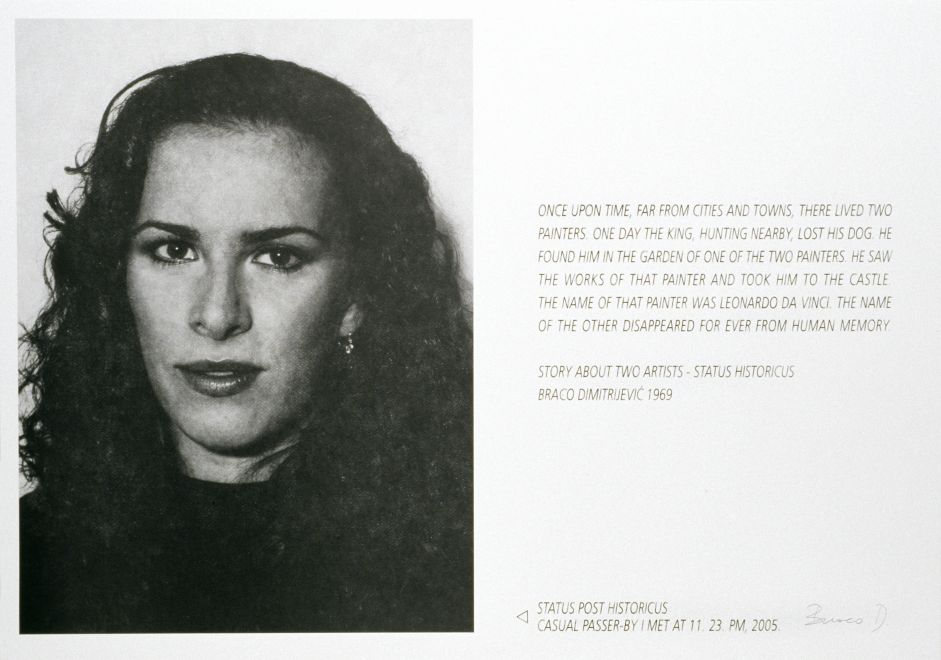
“There are no mistakes in history, the whole of history is a mistake”, declared Braco Dimitrijević in 1969, laying the foundation for his philosophical and artistic exploration of the mechanisms of historiography, which found its first written expression in 1976 in the manifesto-like Tractatus Post Historicus and the introduction of the concept of Post Historie. Dimitrijević’s criticism of linear historiography, including its mechanisms of exclusion, manifests itself in his series The Casual Passer-By I met, created in the 1970s, in which he affixes oversized black and white portraits of random passers-by to facades in urban spaces. By placing the casual passers-by in the place of the politicians and other famous people who would normally be seen there, Dimitrijević takes the codes of the consolidation of power through visual representation in public space and in the mass media ad absurdum: “I am opposed to all stereotypes in thinking and behavior. For instance, the large-scale Casual Passers-by were obviously a resistance to the cult of the personality as well as a critique of certain automatisms conditioned by the media. What I wanted to do was to create a reversal in meaning, and sometimes this has been successful.”1
The offset print The Casual Passer-By I met, created for the print portfolio Love It or Leave It (EB66), ties in with the series and quotes the short fable Story about two artists. According to this story, Leonardo da Vinci only went down in art history due to the fact that the king’s dog happened to get lost in his garden, while other artists were forgotten as nameless. Next to the text is the portrait of a random passer-by, which can be read as a symbol of the multitude of coexisting possibilities and truths that make up Dimitrijević’s Post Historie.
Text: Katrin Seemann
1 Braco Dimitrijević, in: Jean-Hubert Martin, „Interview with Braco Dimitrijević”, in: Braco Dimitrijević (ed.), Braco Dimitrijević, Milano: Edizioni Charta 2006, p. 13.