Joseph Beuys
Silberbesen und Besen ohne Haare
1972
EB36
Horsehair, wood, silver, cooper, felt; height of the silver broom 139 cm, height of the copper broom 130 cm, width of each 51 cm
Edition of 20 + 4 AP, unsigned
out of stock
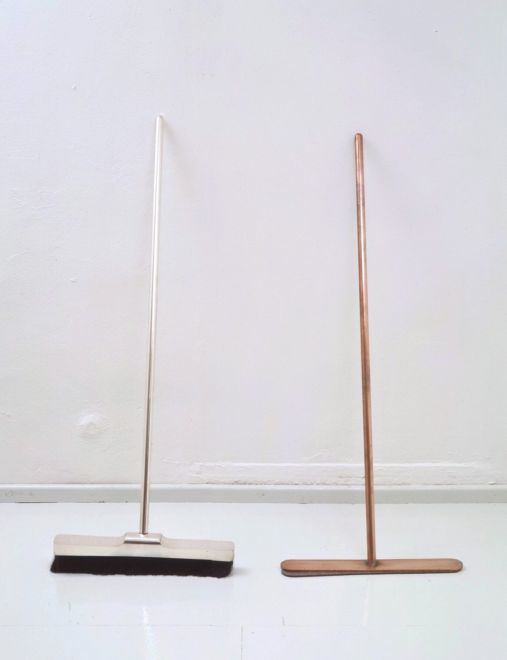
The edition Silberbesen und Besen ohne Haare consists of an unequal pair of brooms standing against the wall, the result of an elaborate manufacturing process. The silver broom is a custom-made mill broom with black horsehair and a 1 mm thick silver sheath that leaves the horsehair free. The details of the edition are stamped into the sheathed base: JOSEPH BEUYS / BESEN I 1972 / © EDITION BLOCK / BERLIN / …/20; there is also a silver stamp (“925”). The second broom made of solid copper, which is lined with felt instead of bristles, was also made especially for the edition and is stamped with “Besen II” on the base. The silver broom in particular required various craftsmanship skills and production steps. A broom maker in southern Germany made the necessary wooden parts of a mill broom with the characteristic narrow holes in the crosspiece, which were fitted with horsehair in a Berlin workshop for the blind. The exact specifications are based on a broom that Beuys used every day in his studio. For the sheathing of the wooden broom handles, silver tubes were first commissioned from Degussa in Mannheim, which were then drawn onto the brooms in the next step by Max van Ooyen, a goldsmith from Kevelaer on the Lower Rhine, sealed and connected to the sheathing of the base piece. The copper broom was made by hand at the art academy in Düsseldorf. During the elaborate and lengthy production process of the edition, the idea arose to develop an action for Berlin in which sweeping already becomes a theme.
The action Ausfegen (Sweeping out) takes place on May 1, 1972 on Karl-Marx-Platz in Berlin-Neukölln. After demonstrators from various left-wing groups had passed by on Labor Day, Beuys swept the square with a characteristic street broom with red bristles together with the Togolese student El Loko and the Korean student Hiroshe Hirose. “I wanted to make it clear,” says Beuys about the action, ”that the ideology-fixated orientation of the demonstrators must also be swept out, namely what was proclaimed as the dictatorship of the proletariat on the banners.”1 They collect the swept-up garbage in plastic bags from the Organisation für Direkte Demokratie (Organization for Direct Democracy) which are printed with the Beuys-drawn scheme “So kann die Parteiendiktatur überwunden werden!” (This is how the party dictatorship can be overcome!). That same evening, the filled bags are displayed at the opening of the exhibition Joseph Beuys. Ausfegen (Sweeping Out) exhibition at the Galerie Block and in 1985, on the occasion of the Hamburg Peace Biennale Dem Frieden eine Form geben (Giving Peace a Form), they were included in the display Ausfegen (Sweeping Out) (1985) together with the street broom with its characteristic red bristles. For Beuys, sweeping is literally and metaphorically part of a cleaning process, a process of clarification and demonstration, which is intended to point out entrenched ideas and blind spots. Even after his dismissal in October 1972, Beuys swept the corridor of the art academy in Düsseldorf.
Against this background, it becomes clear why Beuys describes editions such as Silberbesen and Besen ohne Haare as vehicles: “I am interested in the dissemination of physical vehicles in the form of editions because I am interested in the dissemination of ideas. The objects are only understandable in the context of my ideas. What happens in my political work has a different effect on people through the presence of such a product than if it only arrived by means of written words. Even if the products may not seem at all suitable for bringing about political change, I believe they have a greater impact than if the ideas were directly visible in them. What is important to me is the vehicle character of the editions …”2
Text: Birgit Eusterschulte
1 Beuys, in: Götz Adriani, Winfried Konnertz, Karin Thomas, Joseph Beuys. Leben und Werk, DuMont Buchverlag: Cologne 1986, p. 292.
2 Beuys, in: Jörg Schellmann, Bernd Klüser, »Fragen an Joseph Beuys«, in: Jörg Schellmann (ed.), Joseph Beuys. Die Multiples. Werkverzeichnis der Auflagenobjekte und Druckgraphik, München, New York, 7th revised edition 1992, pp. 9-28, p. 9.