Halil Altındere
Love it or Leave it
2005
EB66
4-color offset print
70 x 100 cm
Edition of 100, signed and numbered
Edition A: 55 copies (numbered 1/55 - 55/55, all in portfolios)
Edition B: 35 copies (numbered I/XXXV - XXXV/XXXV)
10 Artists Proofs (numbered AP 1/10 - AP 10/10)
400 Euro (Edition B)
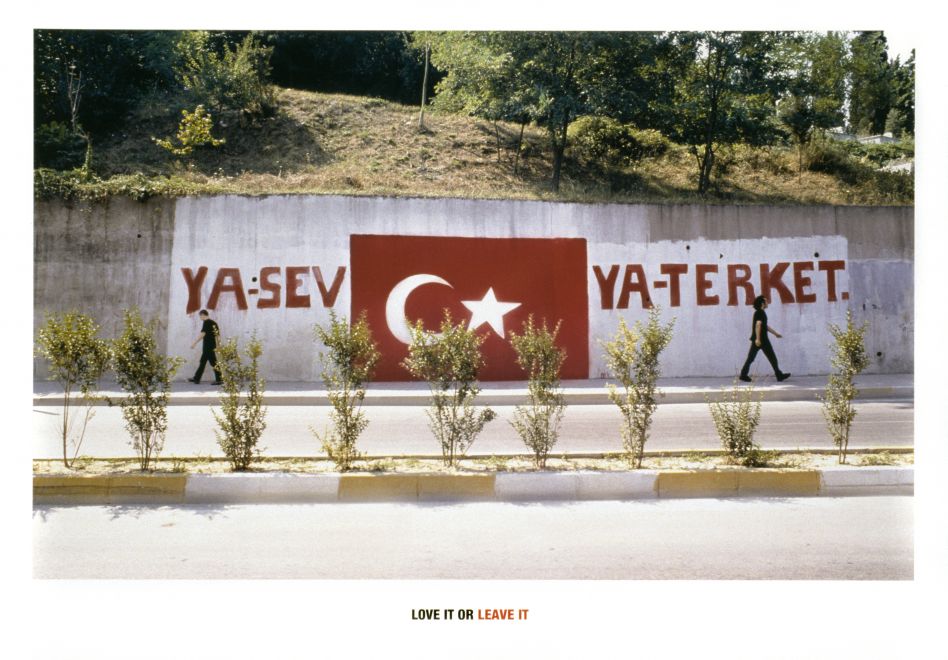
The multicolored offset print from 2005 is Halil Altındere’s contribution to the graphic portfolio of the same name Love It or Leave It (EB66). It shows the graffito of a Turkish flag on a large street, which Altındere found on a wall in Istanbul; the flag is framed by the slogan Ya Sev Ya Terk Et (Love it or Leave it).
Two people are walking away from the graffito in opposite directions. They are the artist himself (right) and his friend, curator and critic Erden Kosova (left). Love it or Leave it is a work from 1998. The slogan, which originally goes back to Benito Mussolini, is to be read against the backdrop of the specific political and social situation in Turkey in the 1990s.1 A time that artist Şener Özmen, a friend of Altındere, describes as follows: “Turkey was, from the middle of the 1980s to the middle of the 1990s, the sanctuary of a dilemma which oscillated between loving (opening its borders to those who love the country) and leaving (showing the borders to those who didn’t love it).”2
As part of the 5th Cetinje Biennale 2004, Love it or Leave it was shown in the form of a billboard in the main street and promenade as well as in other places in the former capital of Montenegro and also gave the Biennale its title.
Printed 2005 by MAS Print House, Istanbul.
Text: Katrin Seemann
1 Cf. Barbara Heinrich, „If I can ́t dance, it is not my revolution“, in: Azra Tüzünoğlu (Hg.), If I Can’t Dance It Is Not My Revolution / Dans edemediğim devrim benim değildir, Exhib. cat., Pilot, Istanbul, 2011, p. 33.
2 Şener Özmen, in: Şener Özmen, „Love it or leave it, but never cheat it!”, in: Love It or Leave It. 5. Cetinjsko bijenale / Cetinje Biennial V, Exhib. cat., Cetinje: Narodni muzej Crne Gore / National Museum of Montenegro; Kassel: Kunsthalle Fridericianum, 2004, p. 23.