K.H. Hödicke
Windrad
1970
EB28
Propeller, 4 postcards, mounted on a wooden frame
69 x 30 x 5 cm
Edition of 12, signed and numbered
4.800 Euro
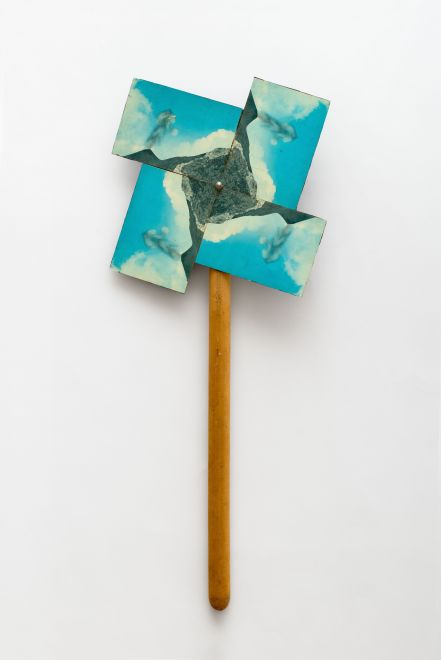
In this rotatable object, four identical postcards depicting a view of the island of Stromboli are attached to a wooden stick. Arranged in such a way that the postcards show the island’s active volcano, the erupting ash becomes the visual jet driving a pinwheel, setting the island in motion and dissolving the visible image of the postcard into a swirl as it spins. Alongside Hödicke’s interest in questions of perception, the depiction of movement in painting and movable objects, we also encounter his fondness for wordplay here: the name of the island Stromboli is derived from the Greek word for “round island”, which in Hödicke’s object is transformed into a rotating island.
The Windrad (pinwheel) is not part of the collection of small objects Hödicke assembled as Der Europäische Reisekoffer for an exhibition in New York, but through its use of postcards it is at least connected to two of the objects in the suitcase. Alongside the prototype of the edition piece Ponte Vecchio (EB35), which spans a postcard of Florence between two bricks as a bridge across the Arno, it corresponds to a postcard from the suitcase depicting a windmill. Beyond this, the object shows clear affinities with the “souvenirs” Hödicke stored in this suitcase. These are “alienated objects which Hödicke collected on his travels,” writes Irene von Zahn on the occasion of the suitcase’s presentation in New York in 1976.1 Windrad too is such a souvenir and, with its ironic playfulness and witty transformation of found everyday items, ties in with Marcel Duchamp. Hödicke’s intense engagement with the French Dadaist, which is also reflected in his window and glass pieces, finds perhaps its clearest expression in an action performed together with René Block, documented by Sender Freies Berlin in 1970 in a film about Galerie Block. On a cold winter’s day, the two sit on white chairs at a small round table with a miniature chess set in ankle-deep snow, playing chess and drinking vodka. “Well, Duchamp was better, wasn’t he?” remarks Hödicke after losing a game, despite having opened with “the famous move Marcel always played,” as he lets his gallerist know at the start of the match.2
Text: Birgit Eusterschulte
1 Irene von Zahn, Der Europäische Koffer, typescript, Archiv René Block 1976.
2 »Das Berliner Fenster«, SFB, 12.03.1970, 32:37 min. director Jan Franksen.