Richard Hamilton
The Critic Laughs
1968-1971
EB30
Dentures (8.7 x 8 x 3 cm) made of dental plastic, electric Braun toothbrush (h: 15.5 cm, ø 4 cm), black plastic base (10 x 10 x 2 cm), all in a case (26.5 x 11 x 6 cm), instructions for use, guarantee card
Edition of 60 + 5 AP, signed and numbered
price on request
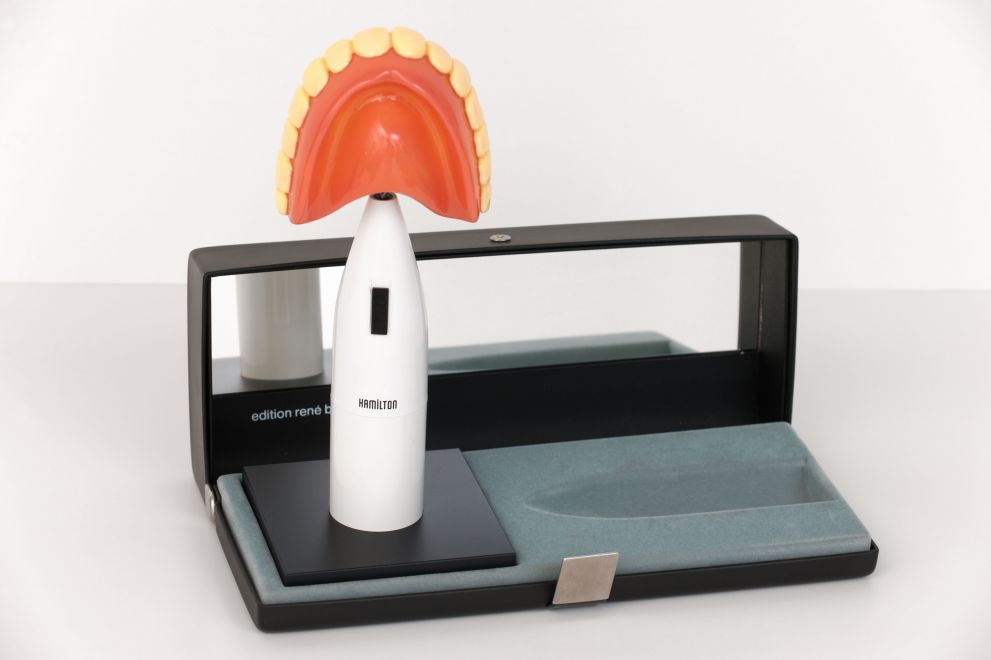
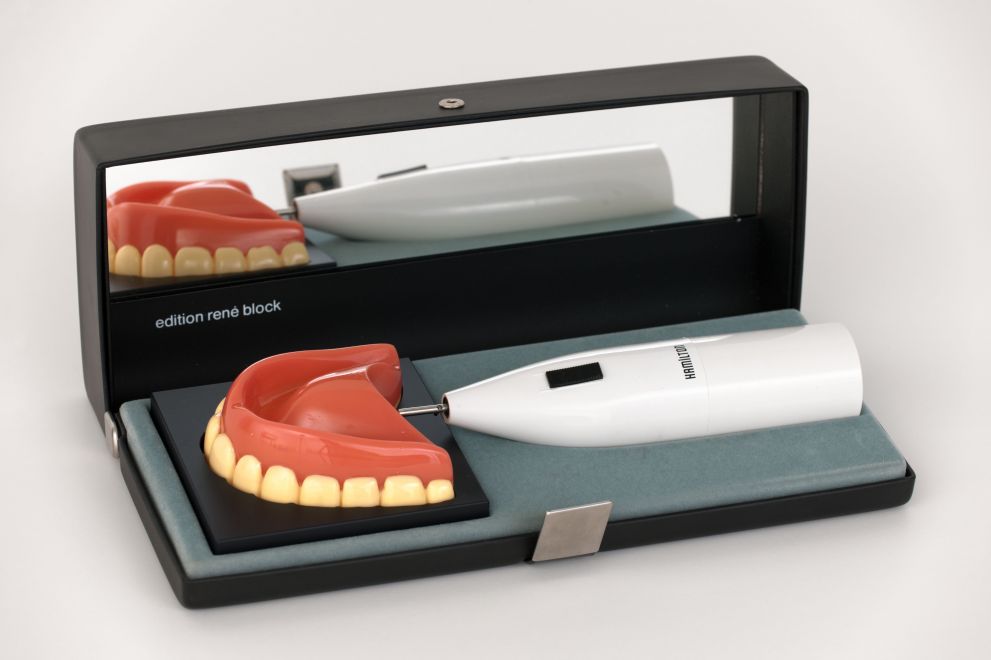
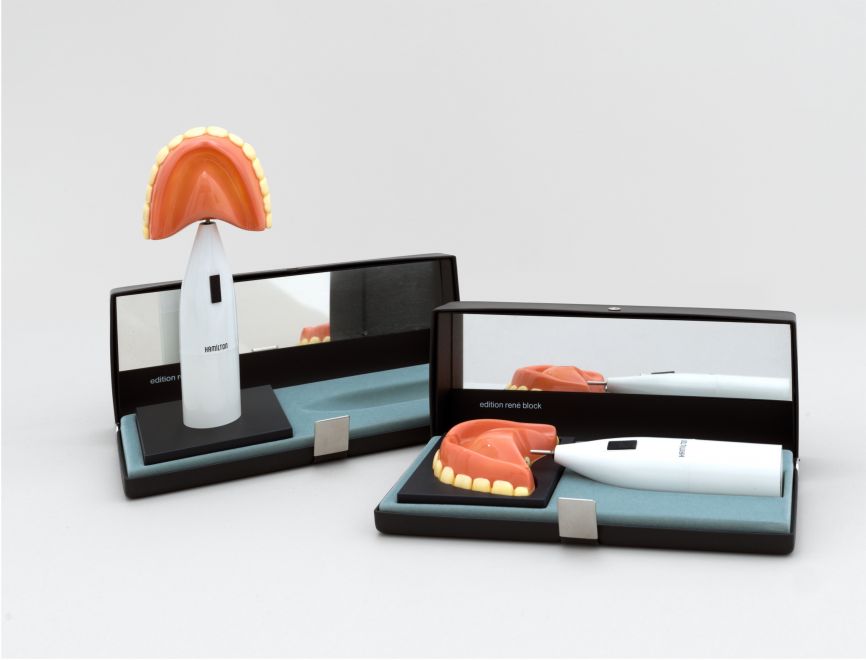
The edition The Critic Laughs consists of a piece of dentures modeled from dental plastic, which is placed on an electric toothbrush from Braun. The object is fitted into a suitably sized case, which is modeled on the Braun Sixtant, a widely used electric shaver from Braun, and adapts the design and characteristic appearance of the brand. The lettering of the type designation on the toothbrush is appropriately headed “Hamilton”. The case is also equipped with a small black base in which the plastic dentures can be stored or the entire object can be set upright for presentation. Richard Hamilton describes the context and creation of the object itself in a short handwritten text:
»The ›Documenta‹ print ›The critic laughs‹ was initiated by a ›readymade‹ object, or to be more precise in our Duchampian terminology a ›readymade assisted‹. It is in association of two mass produced objects – a Braun electric toothbrush and a giantized set of teeth made from sugar (a confection to be found in the English seaside resort Brighton which exemplifies the darker side of British humour). This conjunction immediately reminded me of Jasper John’s ›sculpmetal‹ toothbrush which carries molars instead of bristles. His titles ›the critic smiles‹ seemed too mild for the grotesque shudder of electrically animated teeth – even ›the critic laughs‹ doesn’t quite accomodate this hysteria.
Sugar teeth are a little unhygenic for the permanent needs of art. They ›sweated‹ in certain weather conditions and began to crystalize and crumble away with time. They were also a little heavy for the small motor. Hans Sohm at Stuttgart, the great archivist of Fluxus and ›Happenings‹ documentation (also a dentist) made an excellent simulation of the sugar teeth in dental plastic – inert chemically and also lighter.
The laminated offset-litho version of the subject is, stylistically, in the nature of promotional material for the product. Multiple editioning of the object is an obvious development. As with all consumer products, packaging and presentation posed subsequent problems to be solved by the design at a case styled in the manner of the pack for the Braun sixtant electric razor.
Product, package and promotional matter completes the cycle of the consumer goods industries. Nothing in my experience, and practice, of art suggests that this same cycle does not apply to that category of objects that we label ›art‹.«1 A German translation of the text is included in the catalog Richard Hamilton, published on the occasion of the exhibition Richard Hamilton. A Portrait of the Artist by Francis Bacon at the Block Gallery in 1971.
Hamilton’s description of the edition The Critic Laughs, which was presented by Galerie Block at the Berlin Fachmesse für multiplizierte Kunst (Trade Fair for Multiplied Art) in 1972, gives an idea of the elaborate production process behind Edition Block No. 30. One year later, the exhibition Braun-Projekte provides an insight into the complex production process of the edition and shows the offset lithograph of the same name from 1968, which Hamilton described as the starting point of the project, as well as prints of another Braun product, a toaster designed by Reinhold Weiss from 1961, whose motif Hamilton first used in the offset lithograph Toaster in 1967.
In the exhibition Multiples. Ein Versuch die Entwicklung des Auflagenobjektes darzustellen, which René Block curated for the Neuer Berliner Kunstverein in 1974, The Critic Laughs plays a central role – not only because Hamilton’s object makes it easy to understand the production process of a multiple, which is explained in detail in the accompanying catalog,2 but also because it brings the readymade idea humorously and elaborately into the present.
For the British documentary series The Shock of the New from 1980, in which director Robert Hughes explores the development of modern art, Hamilton adapts a commercial advertisement and, years later, rounds off his examination of Duchamp and the significance of the art object in the consumer goods industry using the example of this edition object. “Hamilton is proud to present its new multiple”, it says in the style of television advertising of the time at the end of the approximately one-minute clip, in which The Critic Laughs is presented to her male counterpart by the actress Loraine Chase as a seductive gift for the connoisseur.
The numbering and signature of the object are engraved on the back of the plastic dentures. In addition to the toothbrush, attachable dentures and base, the case also contains a small, stapled booklet with “Instructions for use” and a guarantee card.
Text: Birgit Eusterschulte
1 Richard Hamilton to René Block, undated text (presumably summer 1971), Archive René Block.
2 Cf. René Block, “Bemerkungen zu Anliegen, Auswahl und Aufbau dieser Ausstellung”, in: Multiples. Ein Versuch die Entwicklung des Auflagenobjektes darzustellen, exhib. cat. Neuer Berliner Kunstverein, Berlin 1974, p. 10-24.