Ludwig Gosewitz
Der Anziehschmit
1967
EB4
Cut-out sheet, offset print
60 x 42 cm
Edition of 150, unsigned
out of stock
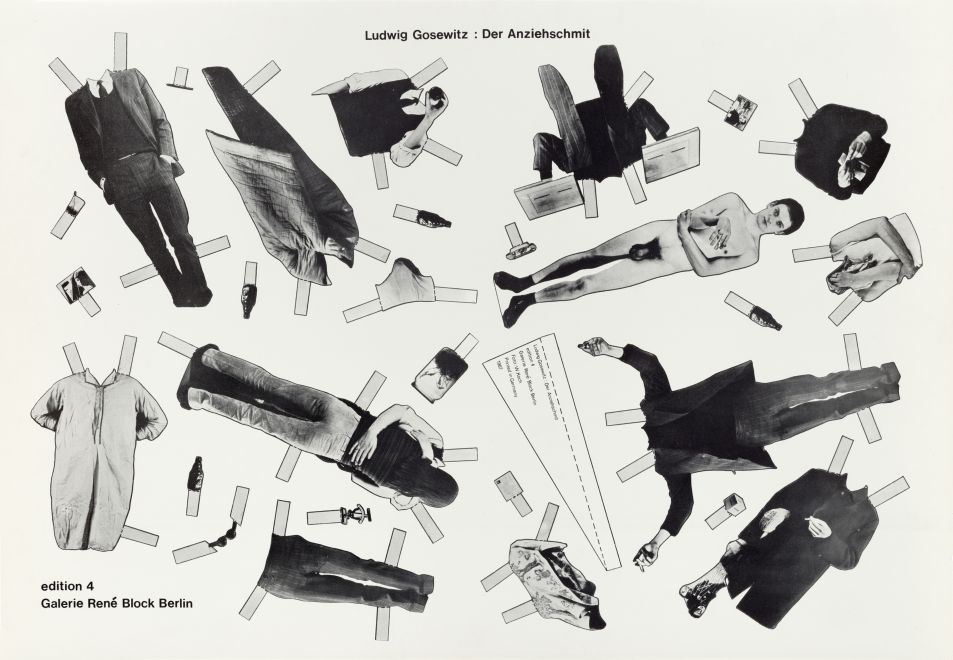
In Der Anziehschmit, Ludwig Gosewitz uses the principle of paper dress-up dolls for a portrait of his friend and fellow artist Tomas Schmit: The cut-out sheet of paper shows the undressed artist with his arms crossed and some of his characteristic items of clothing in typical poses and accessories. With nightgown and suit, writing utensils, glasses and canned poem, rolling a cigarette and a not inconsiderable number of beer bottles, the artist’s daily life can be re-enacted. Schmit described a series of Fluxus-inspired objects made of screw-top glasses, which he filled with typewritten text snippets, cigarette butts, ashes or small everyday objects and labeled “shake well before reading”, as Dosen-Poem (Canned Poem, 1963).
Ludwig Gosewitz, who had been publishing concrete and visual poetry since the early 1960s, and the nineteen-year-old Tomas Schmit first met in 1962 at the Fluxus Festival Parallele Aufführungen neuester Musik in Amsterdam, in which both were involved; Gosewitz was also represented at the Festival der Neuen Kunst organized by Tomas Schmit at the Technische Hochschule Aachen in 1994. Joint Fluxus projects by the two artists, in which they took aim at the art world – themselves included – were created from 1965 onwards, such as the four versions of Denkzettel (1966) with forms for insults to be uttered or the action Eintagstournee (1966), which invited people to eat, drink and smoke with Gosewitz and Schmit at various places and times in Berlin over the course of a day. Gosewitz’s Der Anziehschmit also takes a playful look at the artist’s life. At the same time, the viewer, as Schmit did in many of his own pieces and objects from the 1960s, should be actively involved and lend a hand, which in the case of the edition Der Anziehschmit means cutting up the sheet of paper.
Text: Birgit Eusterschulte