Joseph Beuys
Schlitten
1969
EB18
Sled, flashlight, felt, fat
90 x 35 x 35 cm
Edition of 50 + 5 AP, signature stamped, numbered
out of stock
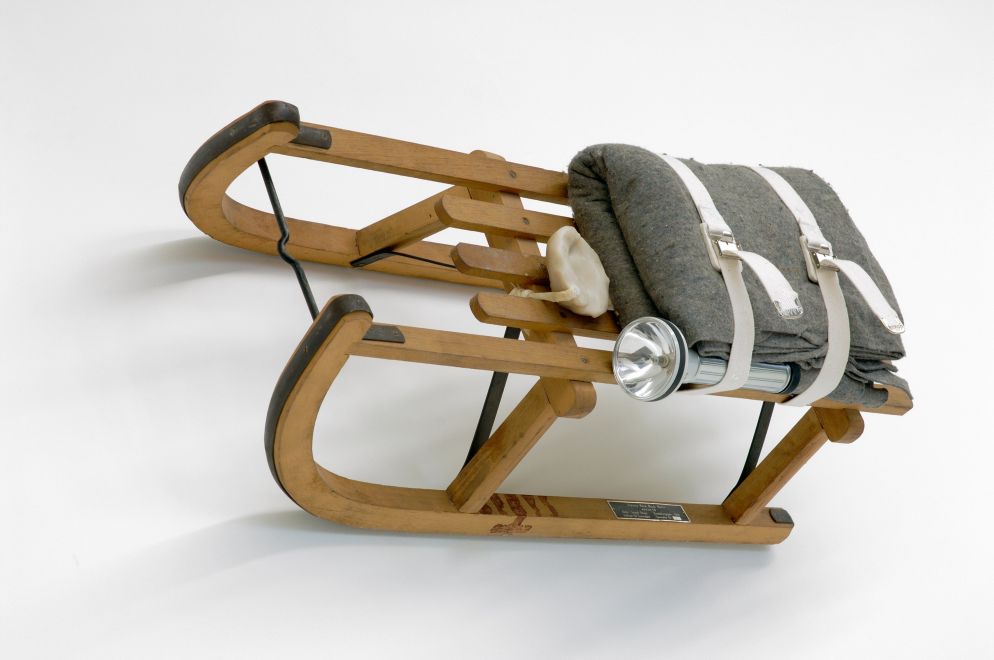
The edition Schlitten (sled) is presented for the first time at the Cologne art market in 1969, where Beuys’ large installation The Pack (Das Rudel) is also shown. Both work with the sled motif, which Beuys had already used in drawings from the 1950s and early 1960s and in the object Urschlitten (1964). Two years after the Cologne art market was founded by the Association of Progressive German Art Dealers, of which René Block had already become the youngest member in 1967, Galerie Block celebrated a great success with the spectacular sale of the large Beuys installation, which is not only to be understood in commercial terms: the demand for what was perceived as a horrendous sum of 110000 DM for The Pack (Das Rudel), whose central components are an old VW bus and 24 modified sleds jumping out of the back, is also a cultural-political statement, as the price is symbolically oriented towards the highly paid artists of American Pop Art Robert Rauschenberg and Andy Warhol. But the multiple is also a success and a statement: Galerie Block offers the unsigned but numbered sled object for a price of DM 300 as an affordable alternative for a broad public and is already selling a large proportion of the edition of 50 on the art market. In the “price difference between the unique piece and the edition”, Block later emphasized his edition activity, “the democratic aspect of multiplication was once again made clear”.1
The idea for an edition that incorporates the element of the sled arose during the production of the multi-part installation. The edition is to be understood as an autonomous object that differs in detail from the sled objects used in the installation The Pack (Das Rudel), even though it is composed of similar components. “Each sled carries survival equipment,” says Beuys, explaining the sled elements of the pack: ”The flashlight embodies the sense of direction, felt provides protection and fat is food.”2 For the edition Schlitten, a different sled model is used with a conventional wooden sled. A folded felt blanket and a flashlight are placed on top of it and fastened to the sled’s seat with straps. As with the sled element in The Pack (Das Rudel, there is also a hardened plastic made from a beeswax-fat mixture on the seat. The mold created by pouring out a fabric filter is somewhat smaller for the edition and is loosely attached to the seat with a molded-in band. The numbering can be found with the edition details on a specially produced small metal plate attached to the top of a runner. The sled is also stamped with Braunkreuz, although the position of the stamp varies.
Beuys explained the connection between the edition Schlitten and the installation in a conversation in December 1970: “Yes, firstly,” Beuys said, “the object is not isolated, but the edition forms a much larger herd than the VW bus. Why should the pack stay together forever? […] So it runs apart. I think that’s just as right as it staying together. In the big environment piece it belongs to the bus and has to stay with the bus, but the edition sleds didn’t even have the bus, this element that makes staying together necessary. The bus with the sleds provokes a terrain and a landscape in which the pack lives. In the edition, on the other hand, there is no reference point to the space, they are simply made in themselves, but they still exist as a pack.”3
In addition to the numbered edition, a reproduction by Dieter Hacker authorized by Beuys and Block exists as an exhibition copy from 1971, without a metal label and stamp, but with a signature.
Text: Birgit Eusterschulte
1 René Block, in: Alte Hasen. René Block im Gespräch mit Gabriele Knapstein, ed. by Susanne Pfeffer, Berlin: KW Institute for Contemporary Art; Cologne: Verlag der Buchhandlung Walther König, 2011, p. 15.
2 Beuys, in: Caroline Tisdall, Joseph Beuys, cat. Guggenheim New York, Thames and Hudson: London 1979, p. 190.
3 Beuys, in: Jörg Schellmann, Bernd Klüser, »Fragen an Joseph Beuys«, in: Jörg Schellmann (ed.), Joseph Beuys. Die Multiples. Werkverzeichnis der Auflagenobjekte und Druckgraphik, München, New York, 7th revised edition 1992, pp. 9-28, p. 16.