Ivan Wyschnegradsky
Kompositionen für Streichquartett und Trio
1990
EB59
CD
Edition of 500
out of stock
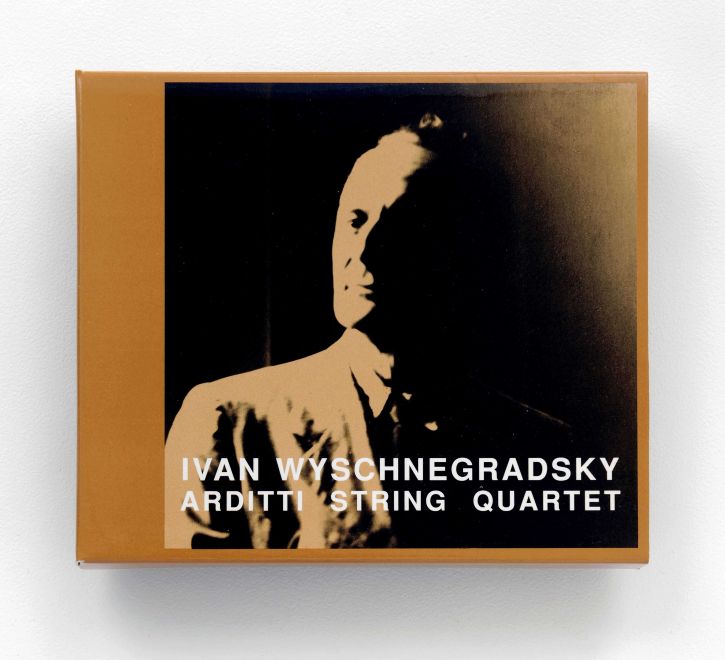
Premier Quatuor à cordes (op. 13); Deuxième Quatuor à cordes (op. 18); Troisième Quatuor à cordes (op. 38 bis); Composition pour Quator à cordes (op. 43); Trio pour violon, alto et violoncelle (op. 53)
Arditti String Quartett
Irvine Arditti, David Alberman, Levine Andrade, Rohan de Saram
“In 1920, Wyschnegradsky emigrated to Paris and traveled to Berlin in 1922, where he met the German and Czech pioneers of quarter-tone music, Willy Moellendorf, Jörg Mager, and Aloïs Hába. He worked with Aloïs Hába on a special piano for the realization of microintervals. Since his residence permit for the German Reich was not renewed, he had to return to Paris. In France, as in Berlin, he encountered a type of music that was completely different from his Russian tradition: in the years after the First World War, people wanted nothing more to do with the grand ideas of “worldview music” of the turn of the century. However, it was precisely the musical tradition of Scriabin and, in his wake, Wyschnegradsky, which aimed at synesthetic Gesamtkunstwerk, that was “ideological music” to a heightened degree. […] The fact that there were only two concerts featuring Wyschnegradsky’s works in Paris until the end of World War II (in 1937 and 1945) proves that the composer remained a musical outsider in Paris. […] The Revue musicale devoted half an issue to his theories on “ultrachromaticism.” But Wyschnegradsky remained a marginal figure, always beyond the current trends that were attracting general interest. Only today, as the outsider is elevated to the status of a protagonist in music history, is Wyschnegradsky’s life’s work, created with admirable steadfastness and continuity, receiving more comprehensive recognition.
String chamber music runs like a narrow but nevertheless significant thread through his entire oeuvre. […] The small number of compositions for strings can be explained by the peculiar nature of Wyschnegradsky’s compositional style. While Paul Hindemith, for example, considered string instruments to be predestined for use in microtonal music because of their infinite intonation possibilities, Wyschnegradsky saw the lack of controllability and accuracy of string intonation as a threat to his idea of micro-interval music.”1
The recording of the works by the Arditti String Quartet was a long-standing project of René Block and was realized in Paris in 1988.
1 Klaus Ebbeke, ‘Ivan Wyschnegradsky’s Compositions for String Quartet and String Trio’, text taken from the booklet accompanying the CD Ivan Wyschnegradsky. Compositions for String Quartet and Trio, Edition Block, 1990, p. 5f.