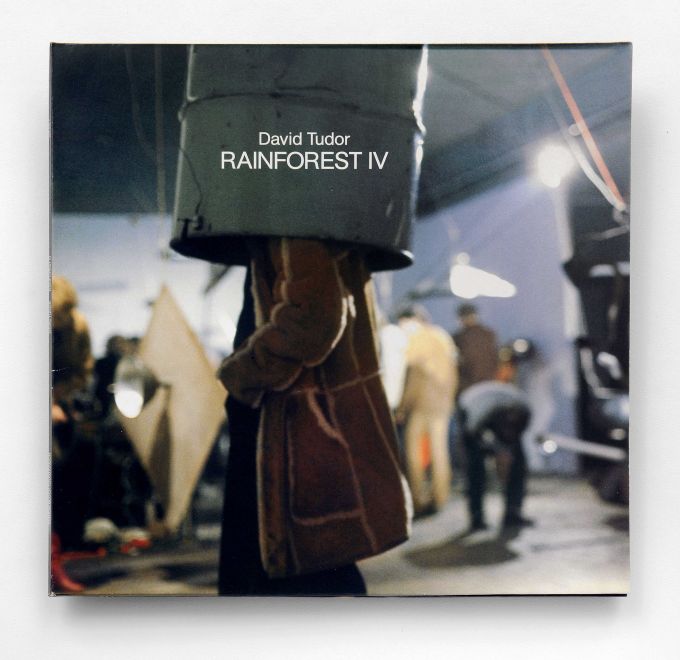
David Tudor’s Rainforest IV is considered a key work in the development of sound art. It was created in various stages (Rainforest II 1969-70, Rainforest III 1972). Its beginnings date back to 1966, when Tudor developed an electronic orchestra for the Merce Cunningham Dance Company.
“The basic ideas for Rainforest go back to 1966, when I developed the idea of an ‘orchestra’ of loudspeakers, each with a unique ‘voice’. The first simple models were presented in 1966 in the production Bandoneon! in New York at 9 Evenings: Theater & Engineering.
Rainforest I, commissioned by the Merce Cunningham Dance Company in 1968, used small-scale ‘instrumental loudspeakers’ whose sound production was mainly heard through a conventional loudspeaker system. In fact, these small instruments were the sound generators.”1
The electro-acoustic environment Rainforest IV was conceived by David Tudor in 1973 and realized for the first time at the symposium The Art of David Tudor by the group Composers Inside Electronics. In this installation, each composer designs and builds up to five sculptures which, under his control, function as instrumental loudspeakers and independently produce sound material to represent the resonant properties of the sculptures. Appreciation of Rainforest IV depends on individual exploration, and the audience is invited to move freely between the sculptures. The recording of Rainforest IV Berlin Version was realized and recorded in January 1980 on the occasion of the exhibition Für Augen und Ohren – Von der Spieluhr zum akustischen Environment (For Eyes and Ears – From Music Box to Acoustic Environment) at the Akademie der Künste. The performers were again the Composers Inside Electronics (John Driscoll, Philip Edelstein, Ralph Jones, Martin Kalve, David Tudor and Bill Viola).
1 David Tudor, text taken from LP David Tudor. Rainforest IV, Edition Block, 1981.