Joseph Beuys / Nam June Paik
In Memoriam George Maciunas
1978/1982
EB48
EB48c:
Double LP, wood, felt, wooden box: 13,6 x 62 x 41 cm
Edition of 47, signed and numbered
out of stock
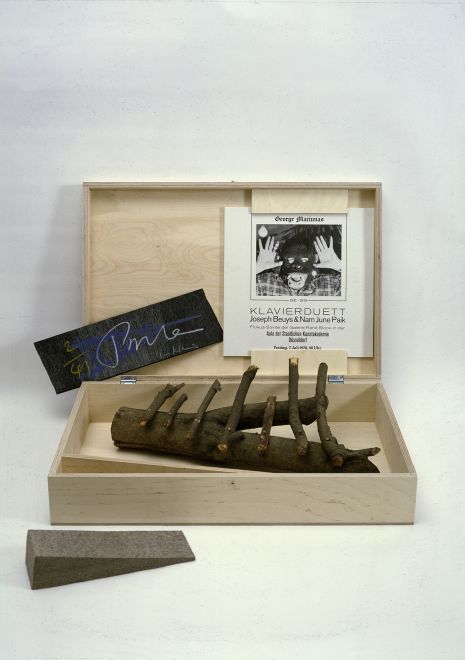
In memory of the artist and founder of the Fluxus movement George Maciunas, who died in May 1978, Joseph Beuys and Nam June Paik performed a piano duet in the auditorium of the State Academy of Art in Düsseldorf on July 7, 1978, which was organized as a Fluxus soirée by Galerie Block. There, at the Düsseldorf Art Academy, the Festum Fluxorum Fluxus. Musik und Antimusik. Das instrumentale Theater took place as the fourth station of an international Fluxus tour conceived by George Maciunas, which Paik had organized in consultation with Maciunas. Beuys had performed his first Fluxus action Sibirische Symphonie 1. Satz at the Festum Fluxorum Fluxus in 1963.
“We set up two pianos,” Beuys describes the piano duet_ In Memoriam George Maciunas_, ”he [Paik] does his thing, I do my thing, we haven’t agreed on what we do. In terms of sound. We meet at this particular point, neither of us knows what the other is doing; the only thing we know and have agreed on is the time.”1 After exactly 74 minutes, the concert ends with an alarm clock ringing. George Maciunas died at the age of 47.
Three different versions have been released under No. 48 of the Edition Block In Memoriam George Maciunas, which emerged from the memorial concert of the same name by Joseph Beuys and Nam June Paik. Two long-playing records with the recording of the piano duet (48 b) are being released in an edition of 500. The cover of the double LP shows George Maciunas with a gorilla mask, as used in his Flux Mass (1970). However, the portrait of the masked artist was created as part of a confrontation with the New York authorities, which Maciunas was trying to evade. The layout of the cover takes up the design of the invitation card, which was developed by René Block and also showed the masked artist. The reproduced and enlarged invitation card, which was also used in this form as an event poster, was printed on canvas using the screen-printing process as number 48a of the edition; the edition is numbered and signed in parts by Joseph Beuys or Nam June Paik, in parts by Joseph Beuys and Nam June Paik.
Beuys and Paik had prepared the grand pianos for the memorial concert using different utensils. Among other things, Beuys used a felt wedge, which he slid under one of the piano legs to insulate it. Such a wedge made of pressed gray felt is included in the third version of the edition In Memoriam George Maciunas. In addition to the felt wedge by Beuys and the double LP of the concert recording, number 48c contains an object by Nam June Paik in a wooden box. Paik’s Urklavier, a forked branch with a keyboard made of smaller branches lying crosswise, can be related back to objects such as Urmusik (1961), which date from the time of his first encounters with Fluxus. A segment in the base of the box is cut out to fit the felt wedge, while the long-playing record is attached to a holder in the lid. While the felt wedge, like the majority of Beuys’ limited editions in the Edition Block, is not signed, parts of Paik’s edition are numbered and signed on an inserted piece of cardboard and include a sketch of the Urklavier. Individual exemplars of the edition are also signed by Beuys on the cover of the record. The exemplars sold after Beuys’ death are stamped by the Beuys estate and signed by Wenzel Beuys.
Text: Birgit Eusterschulte
1 Beuys, in: Georg Jappe, »Am Klavier mit Joseph Beuys«, Kunst Nachrichten, Edition 3, Mai 1985, p. 72.