Sunah Choi
Karo
2020
EB99
Powder-coated steel, rope, DVD,
210 x 52 x 1.5 cm (a), 196 x 62 x 1.5 cm (b), 180 x 74 x 1.5 cm (c)
Edition of 9 (3 variations with 3 pieces each), signed and numbered certificate
3.600 Euro (each)
9.000 Euro (series of 3 variations)
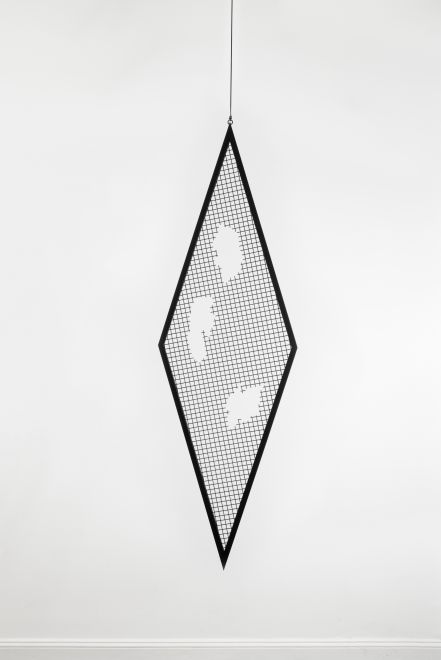
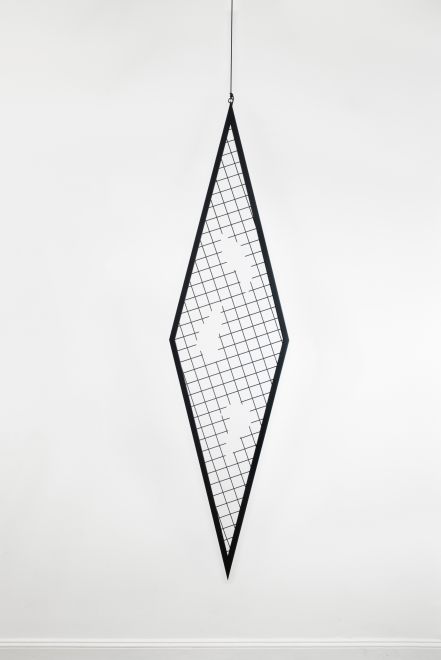
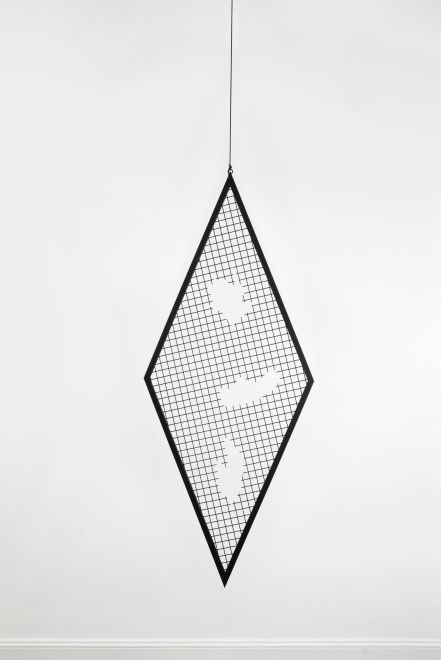
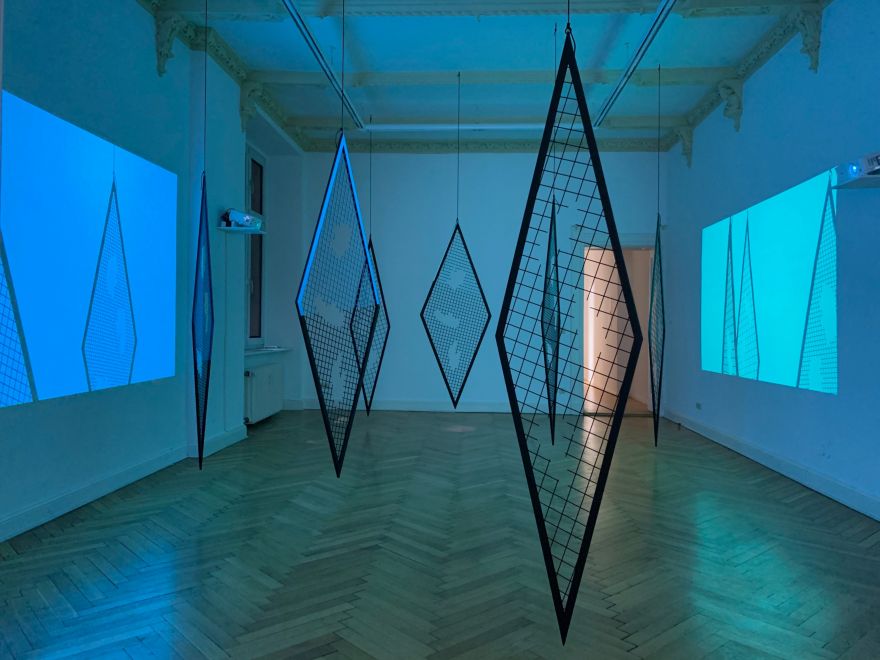
The three-part Edition Karo (in editions of three each) was presented in the space of Edition Block in an expansive installation. The starting point for the work is Sunah Choi’s long-standing preoccupation with the motif of the window as a sculptural element, as well as with the design and function of window grilles, as they have been used for centuries in a wide variety of cultures. They combine functional – protection against breaking in or out – and decorative aspects, geometric and floral forms. The diamond-shaped lattice elements hang freely in the room on ropes, whereby there are three variations, each differing in the angle sizes of the rhombuses and the density of the lattices. They can be read as latticed windows in different foreshortened perspectives but are reduced to absurdity by the lack of architectural integration. Floating freely in space without walls, they become permeable viewing apparatuses that direct the gaze and frame what is seen through them in individual images and sequences. In this way, they are also reminiscent of the frames divided into squares, which have been used since the Renaissance as an aid to measure and perspective drawing and were depicted several times by Albrecht Dürer – for example in his theoretical work Vier Bücher von menschlicher Proportion (Four Books on Human Proportion, 1528), also in perspective foreshortening.
Choi had organically shaped recesses milled into the grids of powder-coated steel, the forms of which in turn are based on leaves that have fallen from trees, which the artist has collected and carefully archived. In their minimalism, albeit radically abstracted, they allude to the ornaments of wrought-iron window grilles, which are often based on plant motifs. The motif of the diamond or diamond shape of a perforated lattice also has its origins in the painting Les épaves de l’ombre (1926) by René Magritte and was taken up and further varied sculpturally by Choi in a series of works. To underline the impression of a window, whose primary function is to let in or regulate light, a projection casts colored light onto a wall – and thus also the shadow of the grid structure. A computer-generated video attached to the object simulates the lighting conditions of a day with imitated light colors – dawn, sunrise, soft morning light, bright midday sun, orange afternoon light, sunset, dusk – whereby the course of twelve hours was calculated down to twelve minutes.
Text: Eva Scharrer