KP Brehmer
Blauskala
1969
EB22
Relief print on plastic, on stretcher frame, 70 x 50 cm
Planned edition of 12, 4 of which were realized, signed and numbered
out of stock
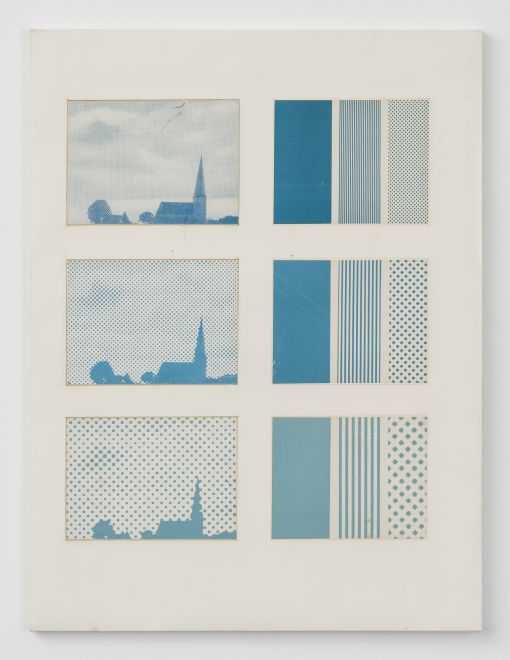
Like the limited edition Ideale Landschaft (Ideal Landscape, EB13), the edition Blauskala is one of KP Brehmer’s color and print sample works that have been created since 1968 and in which the artist examines the meaning of color values in photomechanically reproduced images. In doing so, he reveals the fundamental constructed nature of images, especially those used in advertising and the media, and makes the mechanisms of the economic and political instrumentalization of images visible by literally breaking them down into their individual parts. The graphic Blauskala demonstrates this approach using an image that Brehmer himself took from a reference collection of color samples for cliché printing. The silhouette of a church and some trees at the lower edge of this picture give space above all to the sky and thus to the blue parts of the picture. The motif is repeated three times in different halftone screens and is juxtaposed with the line and dot screens used in an equivalent format. However, the halftone printing process is not only broken down on a visual level. The self-adhesive film on which the motif was printed from a printing plate has itself been cut up and mounted on a white plastic film, which in turn is stretched on a stretcher frame.
The example of the edition Blauskala shows how Brehmer, as a trained printer and experienced reproduction graphic artist, adapts elements of industrial printing and intervenes manually in the printing process, so that original graphic prints emerge from the commercially used printing process, which in principle enables large editions. This also applies to the edition Blauskala, whose concept was to produce each copy in a different shade of blue. However, only four of the planned twelve copies were produced.
Text: Birgit Eusterschulte