KP Brehmer
Deutsche Werte
1967
EB3
Cliché prints and linocuts, cassette with selection bag (envelope), 67 x 50 x 3 cm
Planned edition of 12, of which 6 realized, each piece signed
12.000 Euro
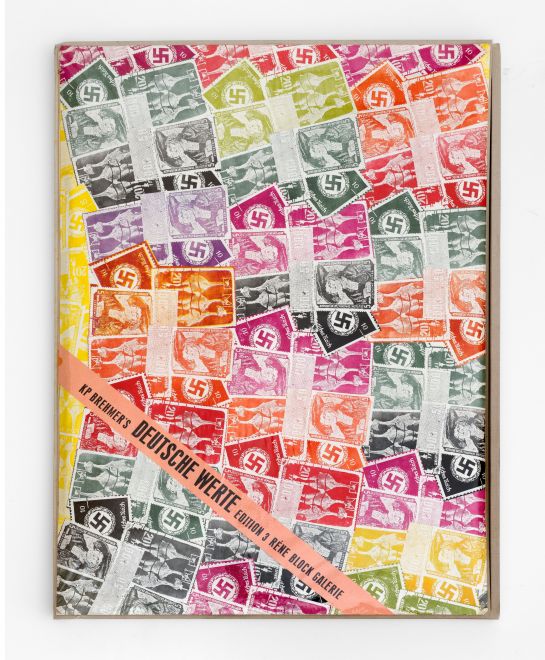
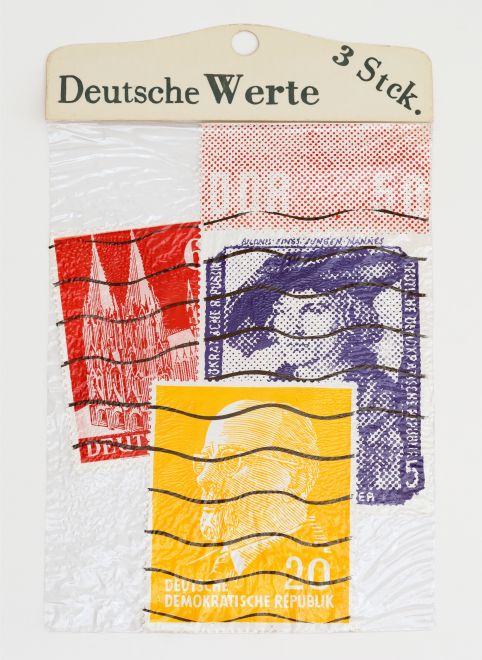

The portfolio with the ironic title Deutsche Werte (German Values) was published on the occasion of the exhibition KP Brehmers Trivialgrafik. Ausstellung von Briefmarken, Aufstellern, Schachteln, etc. at the Galerie Block in March 1967. The cardboard cassette, planned in an edition of 12, contains a selection of Brehmer’s stamp prints created since 1966. The cover of the cassette is laminated with Brehmer’s so called Auswahlbeutel Umschlag (B100a) (selection bag cover). The cassette itself thus becomes part of the edition. The Auswahlbeutel Umschlag is designed like a selection bag with stamps and contains individual stamp prints with repeating motifs, which are printed on art paper using cliché printing (halftone printing process). In addition to the motif of the Wohlstandsmarke (Prosperity Stamp), a stamp designed by Brehmer himself in 1966, he used the motif of an Albrecht Dürer stamp from the GDR in the 1950s and a German swastika stamp for the envelope, both of which he had already issued in separate prints. The six copies of the edition vary slightly in the arrangement of the stamp prints. The Auswahlbeutel Umschlag also has a banderole with the title Deutsche Werte and is foil-wrapped. The cassette contains further prints with modified stamp motifs in different techniques and sizes:
(1) three enlarged and contiguous Deutsches Reich (German Reich) stamps printed in brown on white plastic using the linocut process with a black stamp overprint (B 83),
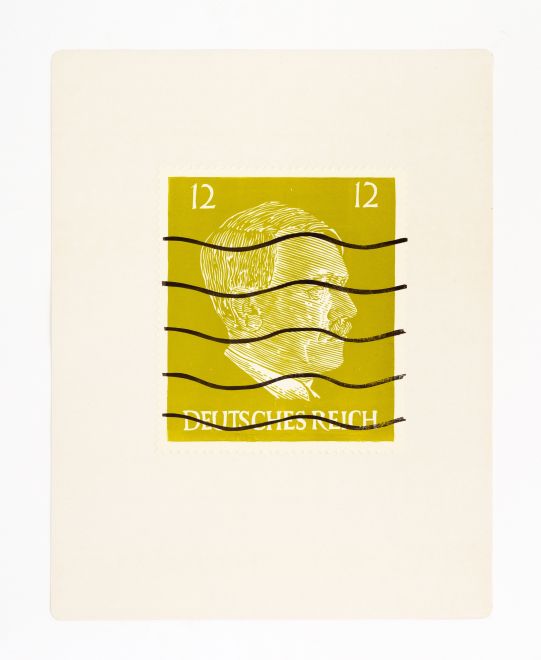
(2) a linocut with the enlarged Hitler stamp motif printed in green on paper with a black stamp overprint (B77),
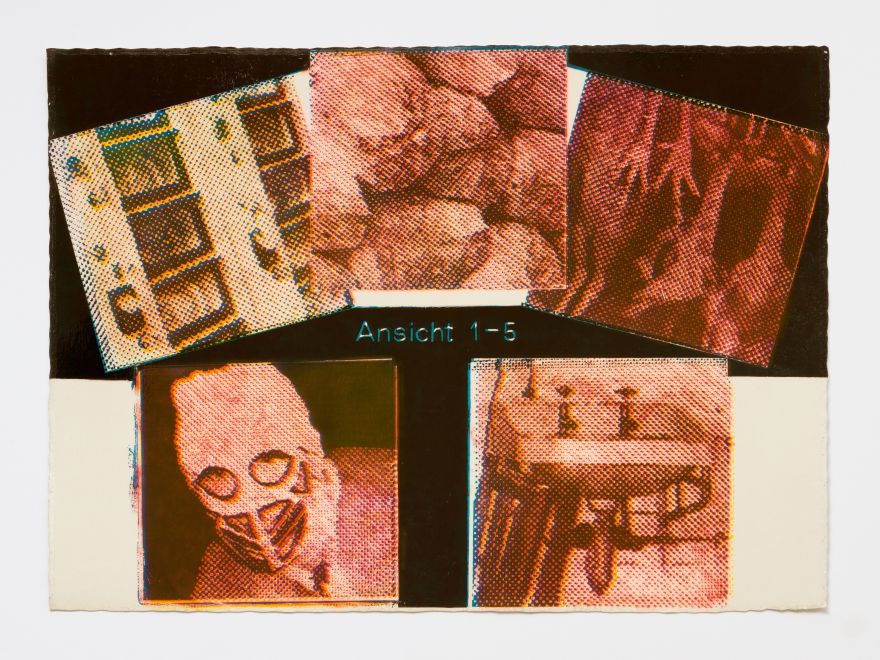
(3) a print on light cardboard in the form of a postcard printed in several colors on both sides using the block printing process, which shows five views from the “Wohlstandsleben” (prosperity life) on the foiled front side and is printed on the reverse side with the rulings of a postcard and the Cologne Cathedral stamp motif in violet (B 102 a/b),
(4) a cliché print in yellow Deutsche Werte (Bogen Hitler) with the reproduction of a sheet of 92 Hitler stamps, which is mounted on cardboard on the inside of the cassette lid, and
(5) a collection bag Deutsche Werte made of transparent plastic with a cardboard label with title imprint, which contains three stamp prints in different arrangements: the cliché print in blue/red Hommage à Dürer, the linocut in yellow Ulbricht and the cliché print in red Cologne Cathedral.
Brehmer explains his interest in the political imagery of the mass medium of stamps in the exhibition catalog Grafische Techniken (1973), in which his graphic work is presented as an example of an examination of the possibilities of industrial printing techniques and the socio-political significance of printmaking. “At the beginning of 1966,” explains Brehmer, “I produced my first oversized stamp, the well-known Hitler stamp, which first flooded Germany and later half of Europe during the ‘1000-year Reich’. This stamp developed into a series of about 50 sheets. The deliberate choice of motifs was not limited to the adoption of existing stamps, some motifs were simplified and made clearer, others were significantly altered by montage (e.g. US POSTAGE stamp: printed matter stamp USA, the globe was added in a certain rotation).
In addition to the content, there was also a formal process. In order to relate the collector of high art quite directly to the trivial area, I developed complicated print variations, different edition sizes, stamped and unstamped, false colors, etc., which delight both stamp and graphic collectors, comparing catalogs of works and stamp catalogs … This project can be seen as a contribution to the sociology of art, and I hope that in this way the graphic consumer will come to a salutary reflection of his situation.”1
With the exception of the prints Deutsche Werte (Bogen Hitler) and Auswahlbeutel Umschlag, which are mounted in and on the lid of the cassette, the prints and the portfolio are numbered and signed.
Text: Birgit Eusterschulte
1 KP Brehmer, in: Grafische Techniken, Exhib. cat., Neuer Berliner Kunstverein [artistic direction and editing René Block], Berlin 1997, p. 27.