Wolf Vostell
Klammerbuch
1966
EB1
Screen print on cardboard, screw clamp
approx. 24 x 12 x 18 cm
Edition of 150, numbered
1.200 Euro
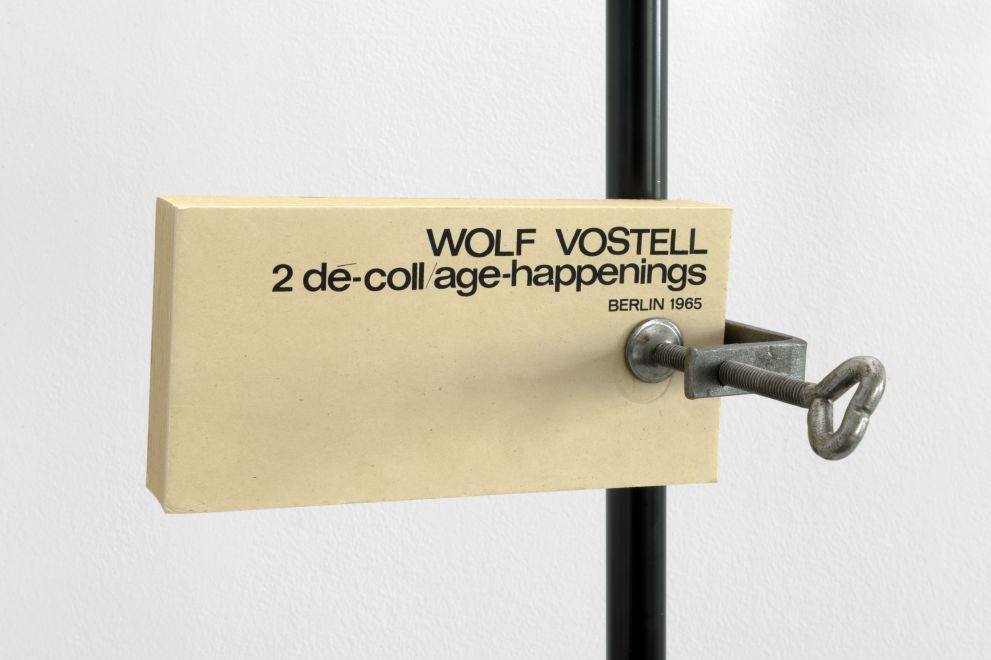
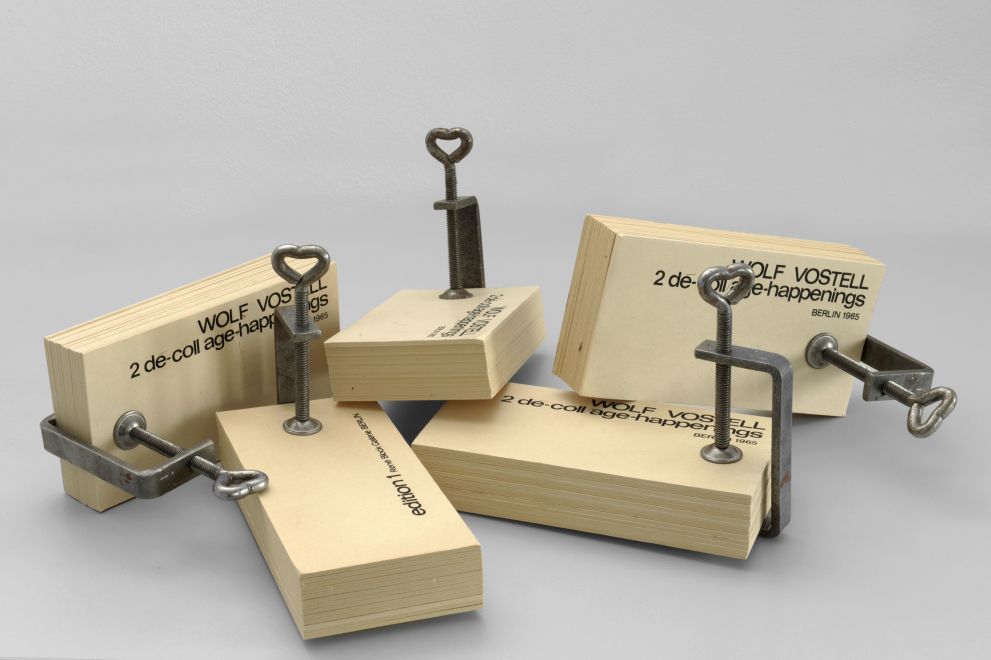
Edition Block began its activities two years after the gallery opened with Wolf Vostell’s Klammerbuch (Clamp Book). Vostell, who had already taken part in the gallery’s first exhibition Neodada, Pop, Décollage, Kapitalistischer Realismus in the fall of 1964, carried out his first Berlin happening and an action the following year: the happening Phänomene at a car cemetery in Schöneberg in the spring and the action Berlin – 100 Ereignisse – 100 Minuten – 100 Stellen (Berlin – 100 Events – 100 Minutes – 100 Places) at various locations in the city in the fall of 1965.
Klammerbuch, a book consisting of 13 individual, cardboard text panels (screen print), is held together by a screw clamp and can also be mounted as an object in space. The individual panels of the book reflect the concepts of the two aforementioned dé-coll/age happenings by Vostell and contain the protocols of the events. 100 Ereignisse, each of which took place for one minute in front of a random audience (zfp), include: “2 staring at the ticket seller in the subway station / zfp 2” or “47 locking the magazine of Der Spiegel with a padlock – throwing out the key at the window / zfp 4”. In the dé-coll/age happening Phaenomene, in which, according to one of the text panels, KP Brehmer, H.C. Artmann, J. Petersen, V. Tsakiridis, P.O. Chotjewitz, L. Gosewitz, H. Hödicke, S.D. Sauerbier, H. Nitsch, M. Luepertz, R. Block and W. Vostell as actors, the audience is invited to climb and crawl “through a path prescribed with cords through the automobile labyrinth” of a car cemetery, having previously received “instructions for action” from the gallery owner. A drawn score of the planned happening is created a few days before its realization in the presence of the participating artists. “In our midst, Vostell sits at his desk over the first notations for the Berlin Phänomene Happening. The outlines of a car graveyard on Sachsendamm are generously fixed onto cardboard. This area soon contains snaking, winding lines: the future paths of the audience in cars, over cars and around cars. Focal points are distributed. […] Vostell has long since reached for colored chalk and accentuates the phases he is currently talking about.”1 Unlike this first graphic score, Klammerbuch lists “20 very dynamic action-packed minutes” in detail on six text panels printed on both sides, which, according to Klammerbuch, were preceded by an action-free phase: “20 minutes the situation is as it is”. Klammerbuch is numbered on the last text panel, on which it is also identified as the first edition of Galerie Block.
Text: Birgit Eusterschulte
1 René Block, “Tage mit Vostell” (July 1966), in: René Block. Ich kenne kein Weekend. Ausstellungsprojekte, Texte und Dokumente seit 1964, ed. by Marius Babias, Birgit Eusterschulte, Stella Rollig, Cologne 2015, pp. 60-63, here p. 62.