Claus Böhmler
Materialien zur Postmoderne in Bild und Ton
1986
EB53
LP with inserted offset print (30 x 60 cm, printed on both sides, folded to 30 x 30 cm)
Edition of 500, unsigned
out of stock
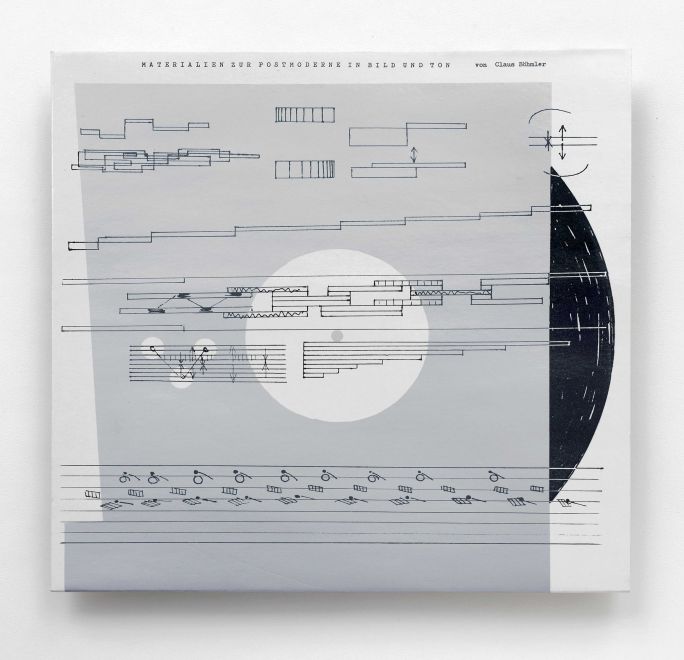
Claus Böhmler works with media. Since they seem to work so well, he takes them apart, examines them or reassembles them. This process does not produce chic moments for the living rooms of communication theorists, sociologists and simulation apocalyptics, but rudimentary raw materials from the wisdom of notebooks, drawings, 35mm cameras, radios, photocopies and cassettes. It is the poor media that open eyes and ears. Not bound to a cultural-bureaucratic administrative apparatus, they assert themselves through a wealth of ideas that fragment, ferment, link and experiment; for, in Böhmler’s opinion, ‘every material is good for thinking’ (K. Gallwitz). Language, which Böhmler sees not only as a commentary but also as a starting point, composition, confusion and instruction, is particularly materialized. Think of a rhinoceros as a gramophone.
Böhmler’s record for this machine, beautifully titled ‘Materialien zur Postmoderne in Bild und Ton’ (Material on postmodernism in image and sound), offers a rich, compact affair. The first side composes three movements with the tape. The linking of tapped, blown, plucked and played sounds produces changing atmospheres and could continue forever like any series of fragments. The accompanying score of this Muzak for progressive idyllics, housewives and car drivers who are not bothered by sports planes was created during the recording of the white pressed record, whose cover design mixes Stockhausen, Rams, typewriter aesthetics and fashion.
The other side of the record features a speech by Böhmler on the new German design (‘die kombi-nation steht kopf!’). The sequence of the recitation becomes fragile, pointed and again a sequence of individual moments, the statement decomposed and multi-layered. Böhmler, who sketches media furniture himself, speaks and makes music polyglotically, i.e. for everyone. His living room lecture ‘Chers amis du meubler perdu, chers auditeurs! Moble party, verehrte wörldstars!’ is an analytical, polyphonic, linguistically playful and compositional essay, more cunning than many a clever recourse.
Michael Glasmeier, in: Katalog 7, October 1986, gelbe MUSIK