Conrad Schnitzler
Eruption
1971-1977
EB26
a)
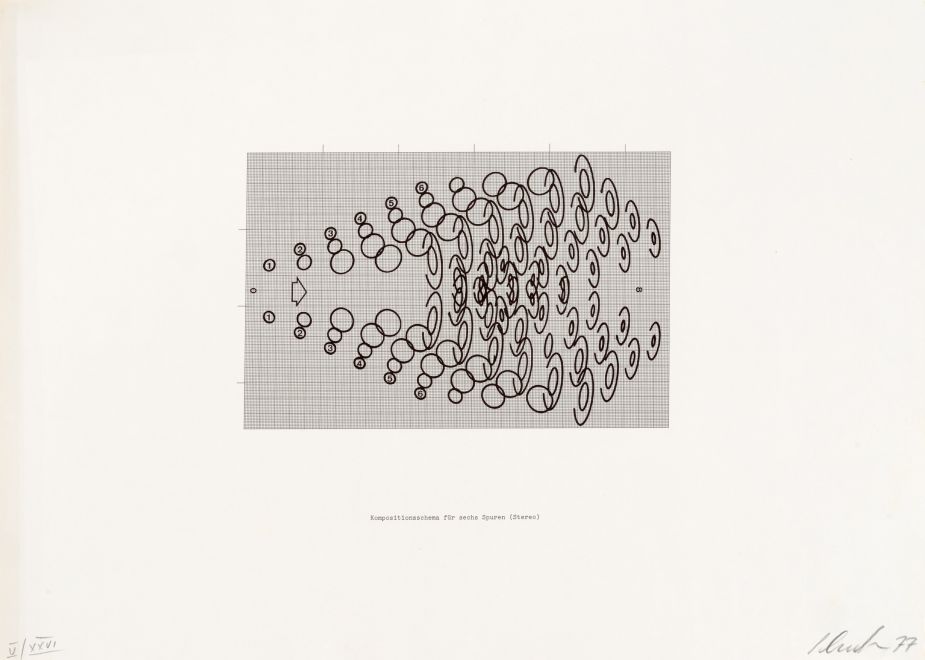
Cardboard with glued-in table of contents, offset print with composition scheme, 3 LPs (black, blue, red) and 1 stereo cassette
31 x 31 x 3 cm
Edition of 100, signed
out of stock


In April 1974, Konrad Schnitzler performed a 50-hour concert at Galerie Block over a period of 13 days. The piece, entitled Work in Progress, was recorded and transferred to a total of 100 music cassettes of 30 minutes each. The first part of the concert on Good Friday, April 12, 1974, with a concert duration of three hours, can be found on cassettes 1-6, the last part of five hours on April 27, 1974 on cassettes 91-100. One of these music cassettes is included in each edition of Eruption, while the complete recording of the concert recording was destroyed.
In addition to the music cassette Detail from Work in Progress (1974), the edition contains three stereo long-playing records and the signed and numbered offset print Kompositionsschema für sechs Spuren (stereo) (Composition Scheme for six tracks (stereo)) in a box. The LPs are inserted into monochrome protective sleeves made of strong paper in different colors; the A- and B-sides contain the following compositions: black – Eruption 1/2 (1971); red – Krautrock/Meditation (1972); blue – Jupiter/Die Rebellen haben sich hinter den Bergen versteckt (1973). The titles of the compositions and publisher’s details are printed on the specially produced labels of the cassette (with numbering of the details contained) and the records.
Before Schnitzler became “the first student of Joseph Beuys in his sculpture class at the art academy in Düsseldorf”, as can be seen in a short biography on the LP box, he had pursued various occupations (“sailor, window cleaner, dishwasher, chauffeur, painter, hippie, smuggler”). After graduating, he founded the group Kluster in Berlin ( together with Dieter Moebius and Hans-Joachim Roedelius), was a member of the band Tangerine Dream and founded the group Eruption (1970-72). “ERUPTION is an outbreak from the usual, from the established, an outbreak to the new, an outbreak to the previously unheard, ERUPTION erupts”1 a collaged sheet (ca. 1970) explains the concept of this formation, which worked with different protagonists between music, visual art and performance. Schnitzler also described his contribution to the exhibition series Elektronische, technische, akustische Räume at Galerie Block in May 1970 as an Electrical Eruption. In the performative spatial installation Kluster-Musik shown there, visitors were able to make twelve electronically amplified violins erupt via radio equipment and interact in an improvised concert.
Copies 1-20 of the edition Eruption are a special edition and also contain six hand-drawn and signed scores for the pieces of music in a canvas box.
Text: Birgit Eusterschulte
1 See illustration of the flyer with explanation of the concept under “Eruption (German band)”, in: Wikipedia. The free encyclopedia, https://de.wikipedia.org/w/index.php?title=Eruption_(deutsche_Band)&oldid=228680176 (accessed on 2.8.2025).