The Indestructable Objects Ten years after Marcel Duchamp had declared the "Bicycle Wheel" his first Readymade to be an artwork, Man Ray created one of his best known works: the "Objet indestructible", the everlasting or indestructable artwork. Both artists used standardized i.e. industrially produced components for their objects. Duchamp mounted a wheel and a frontal fork of a bicycle on to an ordinary stool. Man Ray fixed a photograph of an eye on to the moving arm of a metronome. With these and other Readymades Duchamp and Man Ray established a new aesthetic and a new dimension for artistic techniques: objects, multipliable objects. It was therefore merely consequential, that both objects even several decades later, (1964/ 65), were also produced as artworks in series, as multiples. The history of the multiple is closely connected to that of the object. In particular the artists of the Bauhaus and the Dadaists as artists reflecting society adopted the new technology. 1958, Daniel Spoerri founded the Edition MAT (Multiplication d'Art Transformable) and the old ideas were given new impetus. The artists Agam, Albers, Bury, Duchamp, Gerstner, Mack, Man Ray, Munari, Rot, Soto, Tinguely and Vasarely participated in the "Collection 58". All the objects appeared in edition of a 100 copies, whereby their state was intended to be variable, so that in each case a hundred variations originated from one basic idea.
a.Chr.n. discovery of the silkscreening method in China and Japan.
960-1280 under the Sung Dynasty woodcutting in China
reaches a high level of technical perfection.
about 1400 woodcutting technique is established in West-Europe.
about 1445 invention of bookprinting by Gutenberg.
1796/97 invention of lithography by A. Senefelder.
from 1800 in France and England the industrial process of bronze casting has been . successfully established.
1851 invention of photography by the painter J. Daguerre.
1872 using 24 individual cameras Muybridge makes an analysis of the movement of
. galloping horses.
1877 Edison invents the phonograph.
1892 Edison develops 35mm perforated roll film.
1895 Lumière's cinematograph with the first films on roll film produced by
. Skladanowsky and the brothers Lumière.
1905 invention of offset printing by Rubel, USA.
1913 invention of the art object by Duchamp (first Readymade "Bicycle Wheel").
1919 founding of the Bauhaus by Walter Gropius in Weimar.
1921 Hans Richter shoots the film "Rytmus 21".
1922 Moholy-Nagy initiates the production of pictures by instruction over
the telephone.
1923 "Object indestructible" (Metronome) by Man Ray, who also shoots the film "La . Retour a` la Raison".
1924 Picabia and Clair shoot "Entracte", Leger "Ballet Mécanique".
1926 Marinetti publishes "La Battaglia di Adrianopoli" as a record, with La voce del
. Padrone, Milan.
1927 Duchamp shoots the film "Anaemic Cinema", Ruttmann: "Berlin, Symphonie
. einer Großstadt".
1928 Dali and Bunuel produce the films "Un Chien Andalou" and
1930 "L'Age d'Or".
1936 Walter Benjamin publishes his treatise "The Artwork in the Age of Mechanical
. Reproduction".
1938 "Boite-en-Valise", Duchamp projects his "Portable Museum" on to 300 copies.
1941 110 copies are completed in New York of which 20 are signed and 90 unsigned.
1943 Schwitters publishes "Anna Blume" and "Die Sonate in Urlauten" as a record,
. 100 copies, Lords-Gallery, London.
1944/46 Hans Richter shoots "Dreams that Money Can Buy".
1949/54 Jean Fautrier experiments with different techniques in the simultaneous
. production of originals. His collection "Originaux Multiples" is created and
1950 is presented in New York without success.
1954 Victor Vasarely writes his essay "Towards the Democratisation of Art" with the
. demand for mechanical multiplication of artworks.
Robert Breer shoots "Image by Image I".
1955/58 100 copies of "Boite" are brought out by the Schwarz Gallery, Milan.
1957 the "Kinderbuch" by Diter Rot appears in 100 copies.
1958 30 copies of "Boite" are completed in Paris.
Daniel Spoerri founds the Edition MAT (Multiplication d'Art Transformable)
with works by Agam, Albers, Bury, Duchamp, Gerstner, Mack, Man Ray,
Munari, Rot, Soto, Tinguely and Vasarely
(Collection 58)
1959 "Boite-en-Valise", completion of the edition (60 copies in Paris).
Manzoni brings out his "Corpo d'Aria" in an edition of 45 copies.
Yves Klein's lecture at the Sorbonne appears as a record.
1960 Museum of Krefeld (Dir. Paul Wember) brings out the "Maschinenbild
Haus Lange" by Tinguely in the form of a building plan.
Foundation of the "Groupe de Recherche d'Art Visuel" (LeParc,
Morellet, Sobrino, Stein, Yvaral, Rossi), which investigates the possibilities of
art multiplication in Paris.
1961 various records by Jean Dubuffet.
Diter Rot completes the first "Literaturwürste".
"Künstlerscheiße", Manzoni fills 100 tin cans with 38 g in each.
1962 "Mon Dieu ne l'abandonnez pas" by Ben appears as a record.
Vautier shoots "Regardez-moi cela suffit".
1962-64 Fluxyearbox I, George Maciunas begins the Fluxus editions with Ayo,
Brecht, Congo, Higgins, Jones, Knowles, Kosugi, Kubota, Ligeti,
Maciunas, MacLow, Patterson, Schmit, Shiomi, Vautier, Watts, Williams
and La Monte Young.
1963 Andy Warhol shoots "Sleep", Wolf Vostell: "Sun in your Head".
"Sound of Sculpture" is created by Jean Tinguely as a record with the
Miami-Gallery, Tokyo.
1964 Nam June Paik buys a portable videorecorder in New York and begins to
publish videotapes.
The publishers "Le Soleil Noir" founded in 1948, publishes its first object
book "La Double Vue" with Duchamp, Giacometti, and Lebel.
Stanley Brouwn makes his first 3 books.
The Edition MAT is continued through the gallery Der Spiegel, Cologne.
Various Readymades by Duchamp are edited in an edition of 8 copies by
the Schwarz Gallery, Milan.
This short and insufficient collation shows how, in the second half of the 70s, a calming down in the multiple scene began once more. Two reasons for this can be given. One, the particular interest of young artists in direct communication media, books, records and videotapes; and the other, the always present and serious problem of the distribution of multiplies, which are more complicated to store and export than books, records and videotapes.
Up to now museums were not adjusted to the systematic collection of multiples. Artist's books, records and videotapes can be attended to by Art libraries, for prints there are graphic collections, the object as an original can be included in the sculpture section - for the object produced in series, nobody feels responsible. In particular the newest art developments could be demonstrated representatively and authentically by using multiples. (The exhibition and catalogue "History of the Multiple", 1974 in Berlin, made this evident). In artistic movements like Nouveau Realisme, Kinetic, Pop Art, Happening, Fluxus, Minimal Art, Conceptual Art the essential ideas of
"The future belongs to multiples"
René Block the publisher
Edition Block was founded in 1966 and was located at Schaperstrasse in Berlin, next door to Galerie Block, founded two years earlier. Alongside Edition MAT , Multiples Inc. New York and Milan-based Edition del Deposito, Edition Block is thus one of the oldest publishers of limited edition objects and prints by contemporary international artists. In a text penned in 1972 René Block wrote: "In recent years, the production and distribution of multiples and prints has assumed a quite unexpected status within art. The almost unlimited production potential industrial developments offer means that a critical inquiry into industrial production has become a key element of the work of many artists. Wherever you look, the art dealers have taken artists' focus on the democratization and socialization of the art market seriously and supported the establishment of editions." Here, we can see his intention behind founding an edition, as the focus was on taking up the discussion on the status of the object as kindled by Marcel Duchamp, a debate continued and expanded on in post-War times by Neo Avant-Garde artists and after them in particular by Piero Manzoni, Pop artists and the Fluxus movement. The multiple was not only a way of discussing the problem of the "original", the social status of artistic work and the relationship of art to commodities, as the limited editions also secured the widespread distribution of artistic statements that reflected on the state of art and key issues in contemporary thought. René Block, who presented Neodada, Decollage, and Capitalist Realism in his gallery, took up the debate with his own sure feel for key advances in the concept of art and with his Edition offered artists a platform where they could implement and convey their ideas.
The first Edition Block editions were produced in collaboration with artists associated with the gallery, such as Wolf Vostell, Joseph Beuys, KP Brehmer, KH Hödicke, Sigmar Polke, Palermo or Konrad Lueg and members of the international Fluxus movement, such as Nam June Paik, Arthur Køpcke, Dieter Rot and Robert Filliou. In the years that followed, the program was constantly expanded to include new artists and the latest art forms, and was always influenced by René Block's Fluxus principle of artistic networking and his interest in the periphery and "artistic side-waters". The result was multiplied artworks such as prints, objects, books, not to mention audio and video works. The two first pieces brought out by Edition Block in 1966 were Wolf Vostell's Klammerbuch (ill. 1), which contained the texts on two of his Berlin happenings, as well as Joseph Beuys' … mit Braunkreuz, a linen boxed set containing a drawing, a felt cross cut in half, and two texts. According to René Block, Joseph Beuys was initially little interested in making limited edition objects. This soon changed once he recognized the opportunities multiples offered as regards distribution and reach, as they offered him a means to intensifying the relationship to the works' owners and guiding reception. The first multiple object Beuys made was Evervess II 1 (ill. 2), which he brought out with Edition Block in 1968 in a series of 40 and which highlights his interest in multiplied art. A small wooden box divided into two compartments contained two sodawater bottles of the Evervess brand. One bottle has not been altered, while the other boasts labels made of felt strips. The sliding top to the box contains instructions for the 'user': "Sender beginnt mit der Information, wenn >II< ausgetrunken und der Kronverschluß möglichst weit weggeworfen ist." Through 1982 Joseph Beuys devised additional multiples for Edition Block, that either relate to certain of his works, such as Sleds (1969), the Felt Suit (1970) and Silver broom and hairless broom (1972) or were new creations such as Silence (1973) or were associated with actions, such as In Memoriam Georges Maciunas (1978-82), a piece made together with Nam June Paik. It was with Paik that Block issued the first video multiple in the history of such editions of objects, namely The Thinker (1976/78; ill. p. XX), which conceptually is related to Paik's first TV Buddha installation. This piece is a good example of how intensely and with what variety Edition Block operated, not only at the level of contents, but also as regards the use of the technical production potential. Many of the works published by Edition Block have since assumed a firm place in the canon of art history. One need think only of KP Brehmer's Deutsche Werte (1967), Wolf Vostell's Deutsche Studententapete (1967), Gerhard Richter and Sigmar Polke's Umwandlung (1968), Dieter Rot's Schokoladenplätzchenbild (1969), Richard Hamilton's The Critic Laughs (1968-71; ill. 3) or Marcel Broodthaers' The Manuscript (1974).
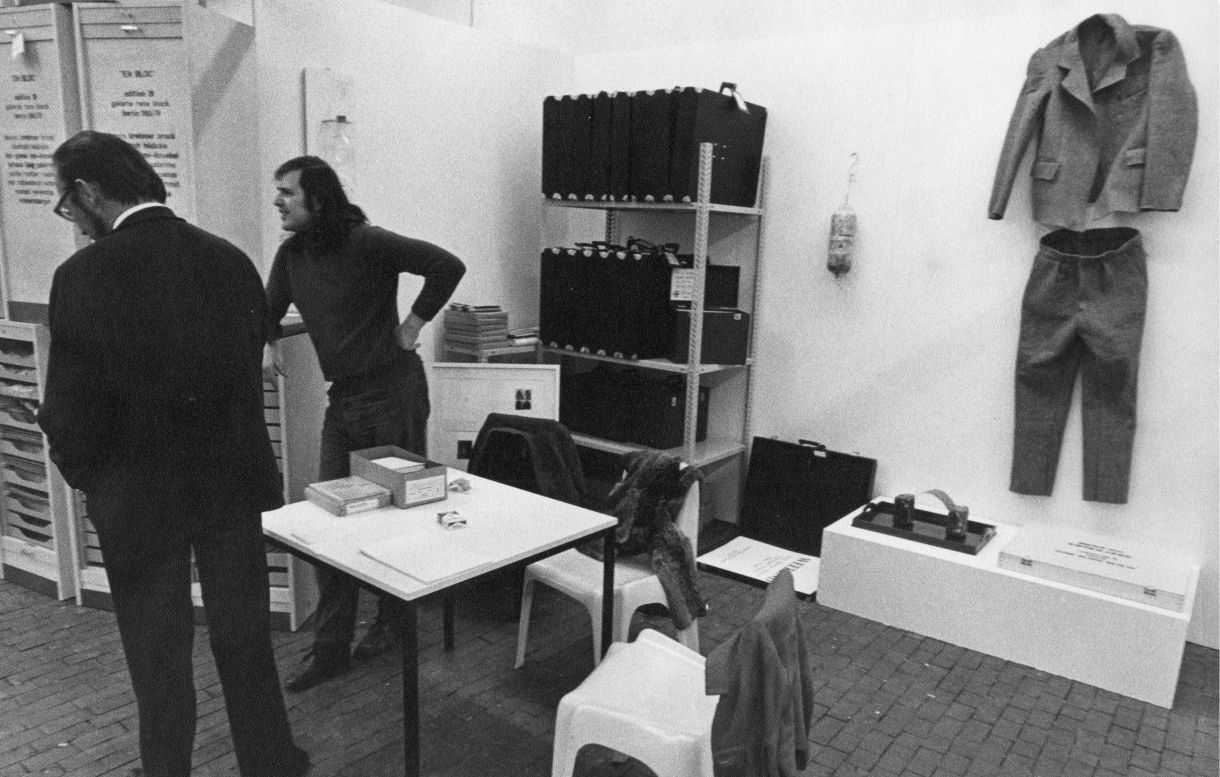
Edition Block's interest has always not only been on limited editions of objects, but above all on prints and the various printing techniques. Alongside bringing out individual sheets by various artists, it has repeatedly published portfolios, such as the 1967 canvas boxed set entitled Grafik des Kapitalistischen Realismus containing silkscreens by KP Brehmer, KH Hödicke, Konrad Lueg, Sigmar Polke, Gerhard Richter and Wolf Vostell. This was followed in 1971 by the book Grafik des Kapitalistischen Realismus with lists of the works of the same artists from 1960 to 1971. That same year, the company also launched Weekend (ill. 4), a suitcase with block prints by KP Brehmer, silkscreens by KH Hödicke, Arthur Køpcke and Wolf Vostell, offset lithos by Peter Hutchinson and Sigmar Polke as well as an object by Joseph Beuys. And in 1988 the Edition issued a portfolio of prints entitled Aus Australien, containing 40 sheets by 8 Australian artists. Not only did it present the Australian art scene to a European audience hitherto unfamiliar with it, but also serves as proof of how the center and the periphery mutually permeate each other in the cultural context - a topic that publisher (and later curator) René Block was to concentrate on in depth in the years to come. Block also pursued the strategy of bringing together several artists for a single joint edition, as nascent in the prints portfolios, on other occasions, too. En Bloc (1969-72; ill. 5), for example, a castor-based wooden container boasted drawers containing objects made by 19 renowned German artists - today, it is a miniature museum.
Just how much he was interested in multiplied art is evident from various projects on which Block worked outside the Edition. In his function as Chairman of the Association of Berlin Art Dealers he insisted that multiples also be the theme of a trade fair. While the first three International Berlin Spring Fairs that the Association organized in 1969-71 were essentially local in thrust, the 4th Fair was far more international in 1972, which the subtitle proclaimed to be the "First Trade Fair for Multiplied Art" and was devoted exclusively to multiples. The decision sparked a fierce debate in the press on the need for such a trade fair, to which René Block responded in the exhibition catalog by firmly championing the multiple. There he wrote that the important trends in art of the last 20 years and the key ideas of the age had first and foremost been realized in the form of multiples, and admonished the institutions of art for not yet having duly taking this trend into account: "Should the museums not at long last - for many things it is already too late - (…) begin to systematically document the development in 'modern art' in the form of multiple originals with due scholarly precision?" And he went on to say "… that the ignorance of public collections continues to ensure that only miniature editions are produced. The result: the normal public can to date hardly afford to buy a multiple. The experiment is in danger of failing." In the same text and fully in keeping with the idea of democratization he suggested that school museums be established in which pupils could familiarize themselves with modern art through the means of multiples. "Concerning themselves with art would then be a matter of course."
In 1972, gallery owner and publisher René Block was invited to curate his very first project: Grafische Techniken, a show organized by Neuer Berliner Kunstverein. Asked what the intention behind the project was, he replied: "There were no reasons steeped in art history. It simply interested me in the 1970s to place artists such as Hamilton, Brehmer, Rot or Warhol (whose silkscreens or offset prints were not recognized as 'artistic prints' - and that continues to be the case as regards taxation and customs duties - alongside the works of classics such as Dürer, Rembrandt, Goya, Klinger or Munch. The idea was more to encourage a rethink among art historians of their standard appreciation." One year later, the project was followed by a show at the same venue entitled Multiples. Ein Versuch, die Entwicklung des Auflagenobjektes darzustellen. Both exhibitions were highly topical and acquainted the broader general public with the lively terrain of multiplied art.
back to menue here
Several years later, 1962, George Maciunas introduced his Fluxus-Edition with the purpose of producing and distributing inexpensive, unlimited artworks. Many small Fluxus boxes were created by Watts, Brecht, Ono, Maciunas, Hendricks, Knowles, Vautier and others. The founding of VICE-Versand by Wolfgang Feelisch in Remscheid, in 1967, was based on the same idea; he went yet one step further to distribute all the products at a uniform price of 8 DM, comparable to that of a paperback book. VICE-Versand achieved an unexpected number of editions for its objects; more than 12.000 of the Beuys-object INTUITION alone were sold in the first the years. In the second half of the sixties the production and distribution of multiples reached a never anticipated, at most hoped for, significance for artistic activities. Owing to the almost boundless manufacturing possibilities offered by industrial development, for many artists the confrontation with the industrial manufacturing process became an important ingredient of their production. Many galleries met with the demands of the artists, for democratization and socialization of the art market, by directing parallel editions. The development of the multiple is most easily demonstrated in tabulated form, including some dates of other multiplication techniques:
1965 The Edition MAT publishes the third object series which contains among others,
the "Objet indestructible" by Man Ray. The series MAT MOT is developed with
language objects by Brecht, Filliou, Henry, Rot, Thomkins, Williams.
Founding of the Edition del Deposito, Milan, and MULTIPLES, Inc., New York.
KP Brehmer broadens his explorations of mechanically produced original
graphics in 3 dimensions; these are stand-up boards, boxes, "Aktionsgraphik".
Number 5 of the avantgarde magazine decollage appears as an object edition
(Gosewitz, Dietrich, Vostell and Beuys "Zwei Fräulein mit leuchtendem Brot").
1966 "Seven Objects in a Box", (Pop Box), with objects by d'Arcangelo, Dine,
Lichtenstein, Oldenburg, Segal, Warhol and Wesselmann, Tanglewood Press,
New York.
Denise René tries in Paris to obtain the copyright for MULTIPLE.
Founding of Edition René Block, Berlin.
The Moderna Museet Stockholm brings out "Knäkkebröd" by Claes Oldenburg, in
an edition of 250 copies.
Fluxfilms by Anderson, Brecht, Shiomi, Watts, Fine, Sharits, Ono, Cale, Jones,
Vanderbeek and Paik.
1967 "Ten from Castelli", graphics and objects by Johns, Judd, Bontecou, Lichtenstein,
Morris, Poons, Rauschenberg, Rosenquist, Stella and Warhol, Tanglewood
Press, New York.
Exhibition of multiplied art, Volkshochschule Cologne.
Founding of the editions VICE-Versand, Remscheid, and Stople-Verlag, Berlin.
Records: Duchamp "Some Texts from A-L'infinitif"
(Aspen) ; Hülsenbeck: "Phantastische Gebete"
(Aspen) ; Warhol: "Wedding of Lucy" (Velvet Underground).
1968 "Evervess II1" appears as the first multiple by Joseph Beuys. (Edition René
Block, Berlin).
Exhibition "ARS MULTIPLICATA" in Kunsthalle Cologne.
Edition Gemini, GEL, is founded in Los Angeles, where "Profile Airflow" (Chrysler
Air Flow) by Claes Oldenburg appears.
The editions Seriaal (Amsterdam) and Petersburg-Press (London) are founded.
1969 "Seven Objects/69" (Bradshaw, Hesse, Kaltenbach, Naumann, Saret, Serra and
Sonnier), Tanglewood Press, New York.
On Kawara completes his "Ten Million Years", consisting of 10 volumes, and
Franz Erhard Walther his "Stoffbuch 1" in an edition of 6 copies.
Founding of X-Art Collection Zürich.
The Edition Tangente starts an object series.
1969-72 "EN BLOC", roll top desk with contributions of 18 German artists: Beuys,
Brehmer, Brock, Dietrich, Giese, Hödicke, Knoebel, Lohaus, Lueg, Palermo,
Polke, Richter, Rot, Rühm, Ruthenbeck, Schmit, Vostell, Wewerka and
Wintersberger, Edition René Block, Berlin.
1970 Exhibition "3--?, New Multiple Art", Whitechapel Art Gallery, London.
Founding of the editions Friedrich, Munich; Hundertmark, Berlin.
1971 Exhibition "Multiples - The First Decade", Philadelphia Museum of Art,
Philedelphia.
Founding of the edition Sperone Multipli, Turin.
Founding of the Video Gallery Gerry Schum, Düsseldorf, which edits videotapes.
(Limited editions among others by: Beuys, Ruthenbeck, Brouwn, Weiner,
Dibbets, Rückriem, Rinke, Roehr).
"Musée de Ben", wooden box with about 50 objects by Ben Vautier, published
by Edition Bischofberger, Zürich.
1972 First FACHMESSE FÜR MULTIPLIZIERTE KUNST, Berlin, with 66 editions from
home and abroad participating.
Howard Wise founds "Electronic Arts Intermix" in New York, a non profit
organization for the production and distribution of videotapes in unlimited
editions.
The wooden box INTUITION by Beuys, which appeared in VICE-Versand,
reaches the total of 4000 copies.
"The Critic Laughs" by Richard Hamilton (Edition René Block, Berlin) is
completed after 2 years of experiments in various places of industrial production.
Records: "Dachskulptur" by Reiner Ruthenbeck (Museum Mönchengladbach)
and "A()" by Lawrence Weiner (Edition Lambert, Paris).
1974 MULTIPLES, an attempt to demonstrate the development of the multiplied
object. Exhibition with catalogue in Berlin.
The multiple INTUITION by Joseph Beuys reaches a total of 8000 copies.
Broodthaers publishes his multiple "The Manuscript" in an edition of 120
copies (Edition René Block, Berlin).
1976 A group of artists and critics founds "Printed Matter" in New York, an organization
for the production and distribution of artist's books.
1977 The art magazine Art in America uses as cover page in colour the Beuys multiple
"Silberbesen und Besen ohne Haare" (silverbroom and broom without Hair).
A paperback "Joseph Beuys/ Multiplizierte Kunst" is issued by the publishers
Schellmann & Klüser.
documenta 6 in Kassel dedicates a special department to the artist's book.
Records: Roman Opalka "1965/1 - ?", (Edition René Block, Berlin); Nam June
Paik "My Jubilee ist unverhemmet", (Edition Lebeer-Hossmann, Hamburg);
Joe Jones, (Edition Harlekin, Wiesbaden).
1978 Nam June Paik publishes the first video multiple "Der Denker", (Edition René
Block, Berlin).
the artists were realized only by the process of multiplication. The abstinence of museums greatly contributed to the fact, that still today in general a multiple has to be produced in smaller editions than an artist's book or artist's record, although the cost of technical development often corresponds to that of a book production. By means of larger editions however the final price could be lowered, so that the object could reach a wider circle of interest, followed again by larger editions and lower prices etc.
The development of the multiple is still going on. New techniques will create new possibilities. Improved distribution will reduce the selling prices.
As Man Ray said in regard to the "Indestructable Object": "To create is divine - to multiply is human."
The future belongs to the multiple!
René Block, January 1979
From 1974 to 1977 René Block's gallery had a branch in New York and during that time he cut back his publishing work. During this period, he only brought out three multiples: Robert Filliou's A World of False Fingerprints (1975; ill. 6); Allan Kaprow's Sweet Wall/Testimonials (1976); and Roman Opalka's LP 1965/1-?. In 1979, after 15 years René Block closed down his Berlin gallery, his artists had all become established names and were now able to survive without his assistance. However, he kept the Edition Block alive and it focused in the years that followed on the relationship between the visual arts and music. This also involved projects to which Block now devoted himself mainly through full-time work for art institutions professionally and in part in his free time. By the time he closed his gallery he was already busy on a major new exhibition project on behalf of the Berlin Academy of Arts that was held in 1980: Für Augen und Ohren. Von der Spieluhr zum akustischen Environment, the world's first comprehensive compilation of what was then the new field of sound art. And in his work for the German Academic Exchange Service, the DAAD, he was able to bring his passion for this special field of art to bear, as here he worked with not only visual artists but also composers who were in Berlin on fellowships, organizing both exhibitions and concerts for them. From 1981 to 1988, Edition Block primarily brought out multiples in the form of LPs with works by Conrad Schnitzler, David Tudor, Ivan Wyschnegradsky, Claus Böhmler, Philip Corner, Henning Christiansen and Gerhard Rühm. One special multiple in the field of music was John Cage's Mozart Mix (1991; ill. p. XX), the latter's homage to the composer Wolfgang Amadeus Mozart. It was the first multiplied sound environment, and came out in an edition of 35: a wooden box containing five cassette recorders and 25 endless cassettes of differing lengths with recordings of different Mozart pieces. Five of these cassettes always played at once: The sound mixture that arose constituted a completely new aural experience with John Cage its author.
From 1993 to 1996, René Block worked for Institut für Auslandsbeziehungen in Stuttgart, and from 1997 to 2006 was Director of Kunsthalle Fridericianum in Kassel. His career took him through different fields of activity involving artists and their works, and we can discern a gradual movement away from supporting artists to art museums, and yet it also saw him working on international shows, above all for biennials the world over. During this time, the Edition was inactive, but Block the publisher was not, increasingly focusing on prints. Thus, during his time in Kassel as Director of Kunsthalle Fridericianum, in connection with exhibition projects there it brought out several editions of prints. They included a series of five early block clay prints by KP Brehmer dating from the 1960s (which were re-issued as a special edition), new offset lithographs by Richard Hamilton and Claus Böhmler as well as a series by Ilya Kabakov, Olaf Metzel and Lawrence Weiner, that appeared in the form of individual sheets accompanying the Chronos & Kairos show in 1999. In connection with various biennial exhibitions Block curated he was able to persuade the institutions behind the shows to dare produce portfolios of prints. In 1985, Dem Frieden eine Form geben appeared on the occasion of the Peace Biennial in Hamburg, a linen boxed set with seven sheets and one object. Robert Filliou, the biennial's initiator, planned it with the goal of re-uniting "art, science and wisdom" in order to achieve a "new authenticity" and thus contribute to peace being achieved. In other words, the portfolio was a logical way of leaving the local platform of Hamburg and made the artists' proposal known to a supra-regional audience. In 1990, it was followed by a portfolio called The Readymade Boomerang for the Sydney Biennial, that traced the history of the ready-mades and the development of the object since Marcel Duchamp, Man Ray and Francis Picabia, juxtaposing this to the works of contemporary artists. The portfolio contained 22 sheets that reflected the theme of the exhibition in terms of content/history and at the practical level. The results are correspondingly diverse, for the experimentation with the most diverse of printing techniques gave rise to a set of prints that reflect an entire epoch of developments in prints. Five years later the Orient/ation portfolio appeared on the occasion of the 1995 Istanbul Biennial, containing 17 sheets and one object. The biennial focused on a re-orientation in cultural policy and aesthetics, highlighting the center/periphery relationship using the example of Istanbul and the upheaval in contemporary Turkish art. It was a very special change of perspective that was also mirrored in the works in the portfolio, in which the artists responded in very different ways to the subject of orientation. All these portfolios served to multiply the respective exhibition and disseminate a knowledge of them. The exhibition's artistic thrust was highlighted on a different level than in the particular exhibition itself or an exhibition catalog. A unique constellation, for not only did it bring together different generations of artists but also crossed geographical borders and created a broader dialogue and new opportunities. Indeed, this reflects Block's notion of the potential of multiplied art.
The subject of reorientation runs like a red thread through the work of curator René Block forthwith, specifically with his ambitious exhibition project The Balkan Trilogy, that he devised in 2003 for the Kassel Kunsthalle and which led in 2004 to the Cetinje Biennial he curated. In connection with this biennial, Edition Block went back into action and in 2005 brought out the prints portfolio Love It or Leave It. In line with the topic of the biennial, the works in it primarily address the implications and potential of artistic work in countries typified by instability and conflict as well as the necessity of and chances for change and the formation of new identities. A total of 30 artists from 12 South European countries participated in the portfolio, the most extensive Edition Block has ever brought out. It brings together younger-generation artists relatively unknown at that point in the West (Sanja Ivekovi? and Mladen Stilinovi?) with internationally established (Marina Abramovi?) counterparts and presents young contemporary positions in art in the Balkans.
In March 2008, René Block (and with him Edition Block) returned to Berlin and continued work, in a new exhibition space. Alongside new pieces produced by young artists from Southern Europe, such as Bülent ?angar (ill. 7) or Šejla Kameri? (ill. 8) it also presents old favorites. For example, Danish Fluxus artist Henning Christiansen is on show with Freedom is round the corner (ill. 9), a neon piece made this year. And musical cross-over artist Carles Santos played the latest Edition Block multiple at the opening: Das wohlpräparierte Klavier
In the course of the last 40-plus years, Edition Block has constantly moved along new paths in the field of multiplied art and thus written part of art history. To date, it has brought out 72 works in collaboration with more than 80 artists (three more multiples are currently planned). All in all, it is a wide-ranging network that has included all the experiences of art in the 1960s, 1970s, 1980s and 1990s, and now with trends in 21st-century art. Joseph Beuys once said: "I am interested in the dissemination of physical vehicles in the form of editions, because I am interested in the spread of ideas … If you have all my multiples, then you have all of me." Perhaps that is also true of publisher René Block.
Barbara Heinrichback to menue here
![]()
The naive desire of the collector, who wishes to own an original object,
can hardly be supported.
Laszlo Moholy-Nagy